
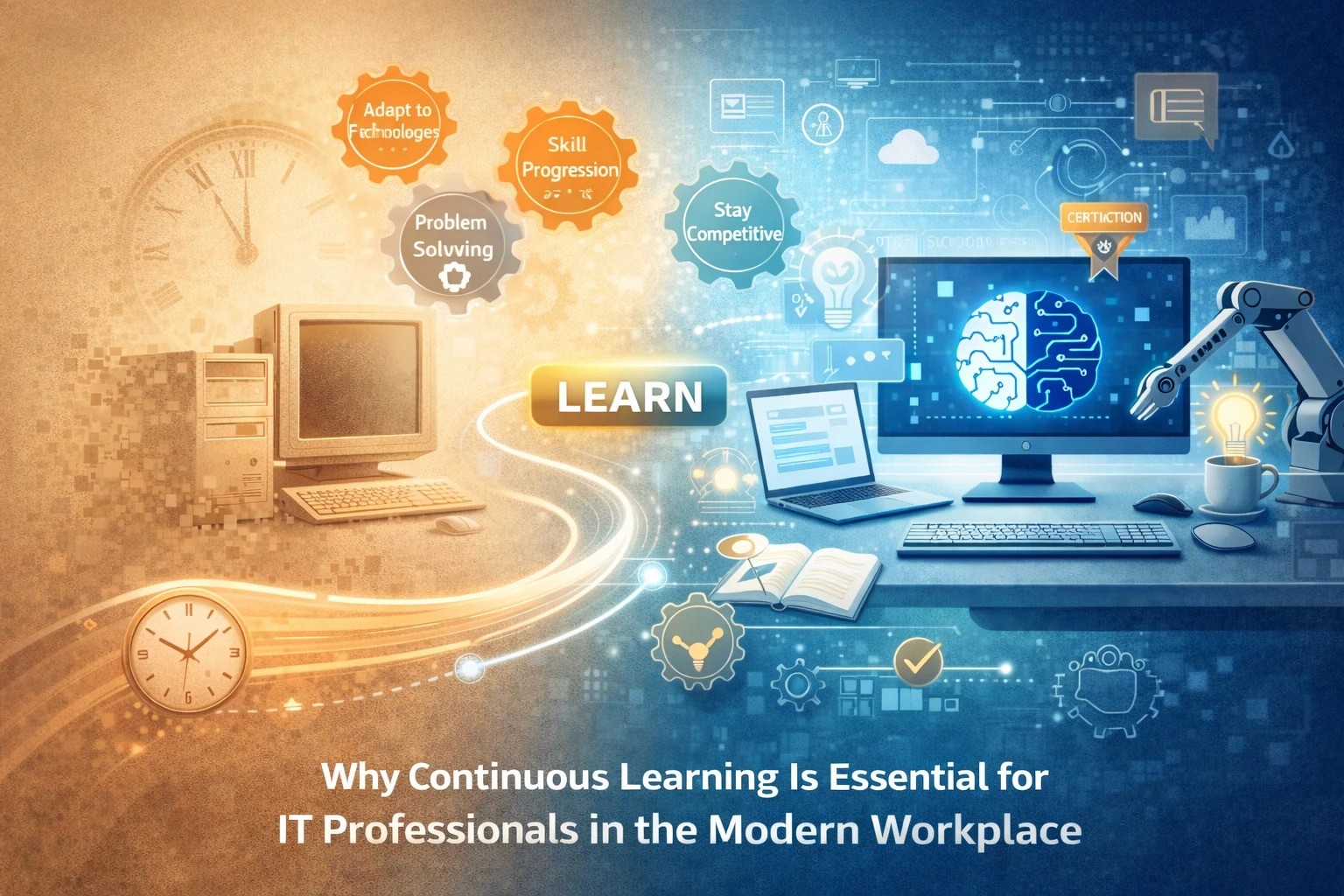
For today’s IT graduates in India—whether preparing for campus placements or starting their first job—the meaning of “learning” has changed. It no longer ends with a degree or a job offer. In the modern IT workplace, continuous learning is not optional; it is essential.
Technologies evolve rapidly, business needs shift, and client expectations grow every year. Skills that were relevant a few years ago can become outdated quickly. This reality affects freshers joining both service-based IT companies and product-based organizations.
This article explains why continuous learning matters so much in the Indian IT job market, what skills freshers should focus on, and how learning can be sustained realistically without high costs.
The Reality of the Modern IT Workplace
The Indian IT industry operates in a fast-changing environment. According to global and Indian industry reports, digital transformation, cloud adoption, automation, and data-driven decision-making continue to reshape how IT teams work.
For freshers, this means:
Job roles evolve faster than college curricula
Tools and frameworks change frequently
Teams expect engineers to adapt, not just execute
Employers no longer hire freshers only for what they know today, but for how quickly they can learn tomorrow.
Why One-Time Learning Is No Longer Enough
In the past, IT careers often followed a stable path: learn one technology, work on it for years, and grow gradually. That model no longer holds true.
1. Technology Changes Rapidly
Programming languages, frameworks, and platforms continuously update. Cloud services, DevOps practices, and data tools are now part of many roles—even entry-level ones.
A fresher who stops learning after onboarding risks becoming irrelevant within a few years.
2. Job Roles Are Becoming Broader
Modern IT roles often combine multiple skill sets:
Developers are expected to understand deployment basics
QA engineers work with automation and CI pipelines
Support roles require data analysis and scripting
Continuous learning allows professionals to handle this role expansion confidently.
3. Client Expectations Keep Rising
In service-based IT companies, employees often work on different client projects. Each project may use new tools, technologies, or business domains. Because of this, teams prefer professionals who can quickly understand what is needed, learn on their own, and start contributing to the work without constant guidance.
How Continuous Learning Impacts Career Growth
1. Better Job Stability
IT professionals who keep learning are more adaptable during project changes, role transitions, or market slowdowns. Adaptability reduces dependency on a single technology or project.
2. Faster Career Progression
Learning enables freshers to:
Take on more responsibility
Move from support to development roles
Grow into senior or lead positions over time
Managers often notice effort toward self-improvement.
3. Stronger Problem-Solving Ability
Continuous learning improves thinking skills, not just technical knowledge. Exposure to new concepts helps professionals approach problems logically and creatively.
Key Learning Areas Freshers Should Focus On
For Indian IT freshers, continuous learning should be strategic, not random. Based on hiring trends and workplace expectations, the following areas are especially important:
1. DSA and Problem-Solving
Data Structures and Algorithms build:
Logical thinking
Structured problem-solving
Confidence in technical interviews
Even in roles where DSA is not used daily, the thinking discipline it develops is valuable.
2. Cloud and DevOps Basics
Cloud platforms and DevOps practices are now common across service and product companies. Freshers should understand:
What cloud computing is
Basics of deployment and environments
How development and operations work together
This knowledge improves collaboration and system understanding.
3. Data and AI Fundamentals
Not every fresher needs to be a data scientist. But understanding:
How data is collected and used
Basic analytics concepts
Where AI fits into modern applications
helps professionals work effectively in data-driven teams.
Continuous Learning in Service vs Product Companies
Service-Based Companies
Learning is often driven by:
Client requirement
Project technology stacks
Domain knowledge
Freshers are expected to upskill quickly when projects change.
Product-Based Companies
Learning focuses on:
Deep understanding of systems
Code quality and performance
Long-term product evolution
Here, continuous learning supports innovation and ownership.
In both environments, learning speed and consistency matter more than initial expertise.
Low-Cost Ways Freshers Can Practice Continuous Learning
Continuous learning does not require expensive courses or certifications.
Practical, low-cost methods include:
Reading official documentation
Practicing coding regularly
Building small personal projects
Learning from peers and senior
Reviewing real project code
Following technology updates and blogs
Consistency matters more than intensity.
The Role of Certifications: A Balanced View
Certifications can be helpful when they:
Validate foundational knowledge
Align with current job roles
Are backed by practical understanding
Certifications can be useful, but they do not automatically prove that a person has real skills or will perform well at work. Employers are more interested in whether you can actually use your knowledge to solve problems.
Freshers should see certifications as a way to support their learning, not as a replacement for hands-on practice and real understanding..
Freshers should view certifications as supporting tools, not replacements for real learning.
How Recruiters View Continuous Learners
Recruiters and hiring managers often look for signs such as:
Willingness to learn new tools
Curiosity about systems and processes
Ability to explain what was recently learner
Improvement over time
These indicators matter especially in entry-level roles, where potential is as important as current knowledge.
Common Mistakes Freshers Make About Learning
Waiting for formal training instead of self-learning
Learning too many things at once without depth
Chasing trends without understanding basics
Assuming learning stops after getting a job
Avoiding these mistakes helps build sustainable growth.
Final Thoughts for Freshers
Continuous learning is not about studying endlessly or chasing every new technology. It is about staying relevant, adaptable, and confident in a changing workplace.
For Indian IT freshers and early-career professionals, learning consistently:
Improves job security
Enables long-term growth
Builds resilience against change
The modern IT career is a marathon, not a sprint. Those who keep learning—steadily and thoughtfully—are the ones who thrive.


