

Ask a final-year student what they wish they had done earlier, and a large number will say the same thing: "I should have done an internship sooner." Ask a second-year student why they have not applied, and you will hear the opposite: "I do not know enough yet," or "Nobody gives internships to second-year students." Both statements keep students stuck. The truth sits in between.
You do not need to be an expert to get an internship. You need basic skills, one or two small projects, a clean resume and a smart way of looking. And you do not need to wait for final year. Many students land their first internship, or a related experience, in their second or third year. Even when a paid internship does not happen yet, there are free, legitimate ways to gain real experience, which this guide explains.
This guide covers the whole journey: what counts as an internship, where to find one, how to apply, how to avoid fake offers, how to evaluate an offer, and how to make the most of it once you start. It also has a section for students who cannot get one yet, because that is a very common situation and it is not the end of the road.
How to use it: read the sections in order if you are starting from zero, or jump to "Where to Find Internships" and "How to Spot and Avoid Internship Scams" if you are already searching. The scam section matters more than it looks, because fake internships specifically target students.
Last checked: facts about portals, programmes and scam patterns were checked in October 2026. Programmes, eligibility and deadlines change every year, so always confirm on the official website before you act.
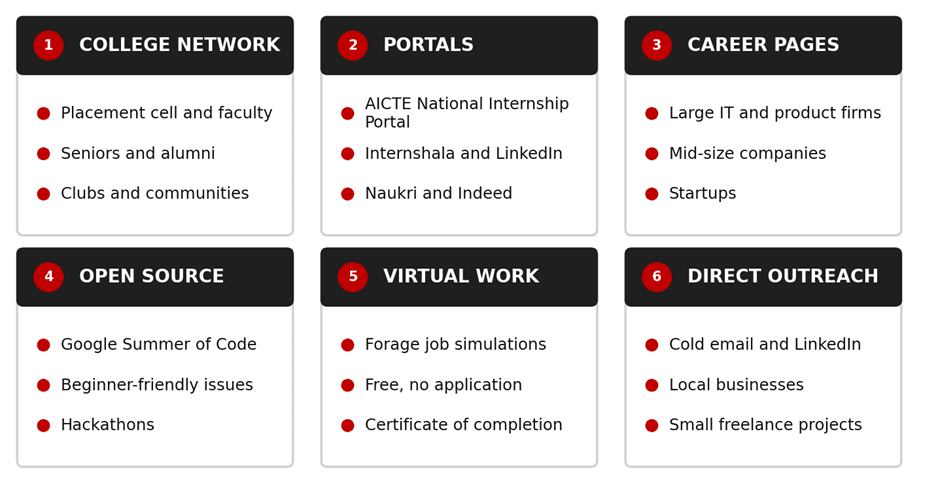
Where Internships Come From
What This Guide Covers
• What counts as an internship, and the different types
• Whether a second or third-year student can realistically get one, and what to aim for each year
• A four-week preparation plan: skills, projects, resume, GitHub and LinkedIn
• Where to find internships, including official portals, open source and free virtual programmes
• How to apply, with templates for a cover note and a cold email
• How to spot and avoid fake internships, and what to do if you are targeted
• How to evaluate an offer, make the most of the internship and turn it into a reference or a job lead
• What to do if you cannot get an internship yet
What Counts as an Internship?
The word "internship" is used loosely, so it helps to know the different forms. Each has a different value.
Type | What it is | Best for | Watch out for |
Paid internship | Work with a company and a monthly stipend | Students with some skills who want real experience and income | Stipends vary a lot by company and role; read the offer carefully |
Unpaid internship | Real work with no stipend | Getting a first experience when paid options are hard to find | Make sure you learn real skills and get a certificate and reference, not just free labour |
Remote internship | Work done online with a company anywhere | Students in smaller cities or with limited options | Verify the company carefully, because scams are common in this category |
College-mandated internship | Training required by your curriculum | Meeting degree requirements | Check whether your college needs an official letter and format |
Virtual work experience | Free job simulations such as those on Forage | Trying a role and adding a project to your resume | These are simulations and not employment; certificates are completion certificates |
Open-source programme | Mentored remote projects such as Google Summer of Code | Students who like coding and can handle independent work | Competitive and not a traditional internship; check eligibility |
A useful rule
The value of an internship is not in its title or the company name. It is in the real work you do, the person who guides you and the proof you can show afterwards. A small internship with a good mentor can teach you more than a famous name with no real tasks.
Can a Second or Third-Year Student Really Get an Internship?
Yes, though what you can expect depends on your year and the type of employer.
Why companies take early-year students: startups and small firms often need help with small, well-defined tasks. They are less strict about final-year status and more interested in whether you can do the work and learn quickly. Some larger companies also run early-career programmes for pre-final-year students, often through selected campuses, so check the careers page of any company you like. Names, eligibility and whether they are open off campus change from year to year, so verify before you plan around any single programme.
What employers realistically look for at this stage: you are not expected to know everything. They look for solid basics in one language, a small project or two, evidence that you finish what you start, and a clear, polite way of communicating. Curiosity counts for a lot.
What to Aim For, Year by Year

If you are in your second year, aim for skill-building and low-pressure experience: virtual work experiences, small projects, hackathons, open-source contributions and short, remote or local internships. If you are in your third year, aim for your first real internship, usually over the summer break or alongside college. In final year, internships often connect directly to full-time offers, though a conversion is never guaranteed.
Step 1: Get Ready in Four Weeks
Most applications fail not because the student lacks talent, but because the application shows nothing. Spend four weeks building the minimum.
Week 1: Choose a direction
Pick one area to target first, such as web development, data analysis, testing or Python development. Applying for everything makes your resume vague. If you are unsure, our guide on choosing an IT role will help. You can always change direction later.
Week 2: Cover the basics of one skill set
• Web or app development: HTML, CSS, JavaScript or one language such as Python or Java, plus Git.
• Data: Excel, SQL and basic Python or a visualisation tool.
• Testing: test case writing, bug reporting and SQL basics.
• Support or IT operations: troubleshooting method, operating system and networking basics, clear writing.
Week 3: Build one small but complete project
A small finished project beats a big unfinished one. Pick a problem you understand, build it, write a README and put it on GitHub. A to-do app, an expense tracker, a small data analysis, or a command-line tool all work. Keep it honest, and be ready to explain every choice you made.
Week 4: Fix your resume, GitHub and LinkedIn
• Resume: one page, projects first, skills grouped clearly, education short. No false claims.
• GitHub: pin your best two projects, each with a README, and remove empty experiments.
• LinkedIn: a clear headline, a short summary, your projects and skills, and a professional photo if you like.
A resume line that works for a student
Compare these two project descriptions.
Weak: "Made a website using HTML and CSS."
Stronger: "Built a responsive portfolio website with HTML, CSS and JavaScript, hosted on GitHub Pages, with a project gallery and a working contact form."
The second version tells the reader what you built, with which tools and where it lives. Add numbers only if they are true. Honest specifics are always better than inflated claims.
Step 2: Where to Find Internships
1. Your college network
This is the most underrated source. Talk to your placement cell, faculty and seniors who have interned. Ask alumni on LinkedIn for a short chat. Many internships, especially at small companies and startups, are never advertised and move through people. A polite, specific message works far better than a mass message.
2. The AICTE National Internship Portal
The portal at https://internship.aicte-india.org is run by AICTE under the Ministry of Education. Registration is free for students, listings include both paid and unpaid internships, and it is mainly designed for students of AICTE-approved institutions. Certificates are issued through the portal after the host organisation marks your internship as complete. Complete your profile fully, because incomplete profiles cannot apply. Note that the portal states a student should never be charged a fee for applying, selection or placement.
3. Internshala, LinkedIn and job portals
Internshala is a widely used internship platform in India, and students and colleges can register for free. LinkedIn, Naukri and Indeed also list internships. Set filters for your skill and location, apply to listings that genuinely match, and keep a record. Internshala also promotes paid training courses, but you never need to buy one to apply for an internship.
4. Company career pages
Go directly to the careers pages of companies you admire, including mid-sized firms and startups, and look for "intern", "trainee" or "apprentice" roles. Applying on the official site is often safer and more reliable than third-party links.
5. Open source and mentored programmes
Google Summer of Code (GSoC) is a global, remote programme where contributors work for 12 or more weeks on an open-source project with mentors and earn a stipend that depends on their country. According to the programme, applicants must be 18 or older, and be students or beginners to open source with less than two years of experience. It is not a traditional internship, and it is competitive. The 2026 applications ran in March, so check the official website early in the year for the next cycle (https://summerofcode.withgoogle.com). Even without GSoC, you can start contributing to beginner-friendly open-source issues at any time.
6. Free virtual work experience
Forage (https://www.theforage.com) offers free virtual job simulations created with employers. They need no application, usually take a few hours, and give you a certificate of completion. These are simulations, not jobs, and the certificates are not formal credentials. Even so, they are a good, free way to try a role and add a concrete line to your resume, especially in second year.
7. Direct outreach to small companies and local businesses
Many small companies need help with a website, a spreadsheet, a database or testing, and never post a listing. A short, polite, specific message can open a door. We provide a template below.
8. Hackathons, clubs and competitions
Student clubs, coding competitions and hackathons are a good way to meet mentors and recruiters, build team experience and create something you can show.

Step 3: How to Apply
Make a shortlist of 15 to 20 targets
Use a simple sheet with the company, role, link, date applied, contact person and status. Quality matters more than volume. A handful of well-matched applications beats one hundred copy-paste ones.
Tailor your resume and write a short cover note
Read the listing and mirror the relevant skills you truly have. Then send a short cover note, not a long essay. Here is a template you can adapt:
Subject: Application for [Role] Intern - [Your Name]
Hello [Name or Hiring Team],
I am a [second/third]-year [degree and branch] student at [college]. I am
interested in the [role] internship because [one specific reason].
I have built [project name], which [one-line description], and I am
comfortable with [skills]. My project is on GitHub: [link].
I am available for [duration] starting [month] and can work [remote/onsite].
My resume is attached. Thank you for your time.
Regards,
[Name] | [Phone] | [LinkedIn]
Reach out directly (cold email for small companies)
Subject: Student volunteer or intern interested in [area] work
Hello [Name],
I am a [year] IT student who enjoys [area]. I noticed that [company]
[one specific observation about their product or website]. I built
[project] and would love to help with a small task, such as [specific
idea], as an intern or volunteer for [duration].
Here is my GitHub: [link]. Could I send my resume?
Thank you,
[Name]
The key is the specific observation and the specific offer. Messages that say only "Please give me an internship" are easy to ignore.
Follow up once, politely
If you hear nothing in about a week, send one short follow-up. Do not message the same person every day.
Prepare for internship interviews
Internship interviews are usually lighter than full-time ones, but they still check basics and attitude. Be ready for:
• "Tell me about yourself." Two minutes: who you are, what you built, what you want to learn.
• "Explain your project." The problem, your approach, one challenge and one improvement.
• Basics of your area: for example loops, OOP, SQL queries or test case design.
• "Why this internship?" A specific, honest reason, not "to learn".
• "What would you do if you got stuck?" Show how you search, try and ask.
Practise answering aloud. Even two practice sessions with a friend improve how you sound.
How to Spot and Avoid Internship Scams
Students are targeted precisely because they are eager and inexperienced. Reported cases include students being "hired" without an interview and then asked for a security deposit, a "certification course" fee, or a payment for a "police clearance certificate". Scammers also use fake LinkedIn profiles and startup pages to collect resumes and personal details, and some pose as college placement cells.
Five Red Flags: Stop Before You Pay

The golden rule
A genuine employer does not charge you money to hire you. Registration fees, security deposits, "refundable" deposits, training fees tied to an offer, and clearance charges are all signs of a scam. The AICTE National Internship Portal states that no fee may be charged to students for applying, selection or placement.
How to verify an internship in ten minutes
1. Check the company website and email domain. Does the recruiter use a company email, or a free email address? Is the website real, with an address and working pages?
2. Search the company name with the word "scam" or "reviews". Look for complaints.
3. Check the recruiter on LinkedIn. A real profile has history, connections and activity.
4. Ask your placement cell or department head. Colleges often know which offers are genuine.
5. Be wary of speed. An offer without any interview, task or conversation is suspicious.
6. Keep communication on official channels. Avoid payments to personal UPI IDs or QR codes.
7. Never share Aadhaar, PAN or bank details before you have verified the employer and signed a genuine offer.
If you have been targeted or lose money
Do not pay more to "recover" money. Keep screenshots and receipts, tell your college, and report it at once. In India you can call the National Cyber Crime Helpline on 1930 and report online at https://cybercrime.gov.in. Quick reporting improves the chance of action.
Step 4: Evaluate an Offer Before You Accept
Getting an offer feels like winning, and it is, but ask a few questions before you say yes.
• Role and tasks: What exactly will I work on? Can I see an example of a recent intern's work?
• Mentor: Who will guide me, and how often will we speak?
• Duration and hours: How long is it, and what are the working hours and time zone?
• Stipend: Is it paid? If unpaid, will I get a certificate, a reference and real tasks?
• Format: Remote, hybrid or onsite? If onsite, what about travel and accommodation?
• Documents: Is there a written offer letter on official letterhead or email? Are there any terms, such as confidentiality or a bond, that you should understand?
• What happens after: Is there a possibility of a full-time offer? Treat this as a possibility, never as a promise.
If you are considering an unpaid internship, it can be worth it for a first experience, but only if the work is genuine, the learning is real and the arrangement is clear in writing.
Step 5: Make the Most of Your Internship
Getting in is half the work. What you do next decides whether the internship becomes a strong line on your resume or a forgotten month.
Your first week
• Ask for a clear picture of your tasks, goals and who to ask when you are stuck.
• Set up your tools and read any documentation before asking basic questions.
• Introduce yourself politely, and learn how the team communicates.
• Start an internship diary (see the template below).
The first month
• Deliver something small and complete early. One finished task earns trust.
• Ask good questions. Try first, then ask with what you tried: "I have tried A and B and I am seeing this error. Could you point me in the right direction?"
• Take feedback calmly and apply it.
• Communicate early if you will miss a deadline.
• Learn how work really happens: version control, code reviews, standups, tickets, testing.
The last two weeks
• Finish what you started and document it so others can continue.
• Ask for feedback: "What should I improve, and what did I do well?"
• Ask your mentor for a reference or a LinkedIn recommendation if the work went well.
• Request your internship certificate and confirm the details are correct.
• Connect with your teammates on LinkedIn.
A simple internship diary
Date: ______
What I worked on today:
What I learned:
What went wrong and how I fixed it:
Questions to ask tomorrow:
One thing I will do better:
Five minutes a day gives you a record you can turn into strong resume lines and interview stories later.
Respect confidentiality
Do not publish confidential company code, data or screenshots on GitHub or social media. You can describe what you did in general terms, but always check what you are allowed to share. Breaking confidentiality can harm your reputation and the people you worked with.
How to Show an Internship on Your Resume and LinkedIn
• Format: Role, company, dates, then two or three bullets on what you did and the tools you used.
• Be specific: "Built three REST API endpoints in Flask and wrote tests for them" beats "Worked on backend tasks".
• Use numbers only if true. Do not invent figures.
• Add the certificate to LinkedIn under licenses and certifications, with the verification link if one exists.
• Tell the story in interviews: the problem, what you did, a mistake and what you learned.
What If You Cannot Get an Internship Yet?
It is common, and it does not mean you are not good enough. Competition is high, timing matters and many students struggle at the beginning. Instead of waiting, build equivalent experience:
• Complete two or three free virtual work experiences and note what you learned.
• Build two real projects and publish them with clear READMEs.
• Contribute to open source, starting with documentation fixes and beginner issues.
• Offer to help a small business or an NGO with a website or a spreadsheet, and ask for a short recommendation.
• Work with a professor on a department project.
• Join a hackathon or organise a small coding event in your college.
• Explore apprenticeships on official platforms such as Apprenticeship India (https://www.apprenticeshipindia.gov.in) and the National Career Service portal (https://www.ncs.gov.in).
Recruiters care about proof of work and initiative. A student with two good projects and some open-source contributions can look as strong as one with a quiet internship.
Mistakes Students Make When Looking for Internships
• Waiting until final year. Start in second or third year, even if it feels early.
• Applying everywhere with one resume. Targeting beats volume.
• Paying for an internship or certificate. Never pay to be hired.
• Ignoring small companies. Startups and small firms often give the most hands-on work.
• Not following up or giving up after a few rejections.
• Treating the internship as a formality. Take real tasks, ask for feedback and collect proof.
• Sharing personal documents too early with unverified recruiters.
Where Structured Guidance Can Help
Preparing for internships is easier with feedback on your resume, projects and interview answers. If you would like guided learning, a centre such as upGrad Learning Support Centre, Pune can be a useful next step to explore, especially if you want structured practice in areas such as full stack development, data science or AI/ML, along with project work and interview preparation.
Structured programmes generally combine a planned curriculum, hands-on projects, mentor guidance and interview preparation. Course content, fees, schedules and eligibility can change, so confirm the latest details directly with the centre.
Before joining any programme, ask whether you will build real projects and get feedback on them, whether mock interviews are included, and whether the curriculum matches what employers ask for today. Be cautious about anyone who guarantees a job, an internship or a salary, because nobody can honestly promise that.
Get Regular Job Updates
Looking for regular IT job updates, fresher opportunities, and career-related updates? Join our WhatsApp group for more job updates and opportunities.
Join our WhatsApp Group:
https://chat.whatsapp.com/KA8HpgjbJ67I5yfQDquCvn
Frequently Asked Questions (FAQs)
Q. Can a second-year student get an internship?
Yes, though options differ from those for final-year students. Startups, small firms, remote roles, virtual work experiences and open-source projects are all realistic. Build a small project first and apply with a clear, tailored resume.
Q. Are internships paid or unpaid?
Both exist. Paid internships give a stipend that varies by company and role, while unpaid internships can still be valuable if the work and mentorship are real. Always understand the terms in writing before you start.
Q. Should I pay for an internship?
No. Genuine employers do not charge candidates to hire them. A request for a registration fee, deposit, certificate fee or clearance fee is a major red flag. The AICTE portal states that students should not be charged for applying, selection or placement.
Q. Is the AICTE internship portal free?
Yes. Registration and applications on the official portal are free for students, though it is mainly designed for students of AICTE-approved institutions. Always use the official portal address and never pay through links sent outside it.
Q. Is Google Summer of Code an internship?
It is a mentored, remote open-source programme with a stipend, but it is not a traditional internship. Applicants must be 18 or older and be students or beginners to open source. Check the official website for the next cycle, as applications are open for a limited period each year.
Q. Do virtual internships like Forage count as experience?
They are job simulations with certificates of completion, not employment. They are useful for trying a role and showing initiative, but they work best alongside real projects.
Q. How do I turn an internship into a job?
Do your tasks well, ask for feedback, document your work, build relationships and ask politely about opportunities near the end. A conversion is never guaranteed, but a strong reference and strong work improve your chances elsewhere too.
Q. What should I do if I think an internship offer is fake?
Stop communicating, do not pay and do not share sensitive documents. Check with your placement cell, save the evidence and report it. In India you can call the National Cyber Crime Helpline on 1930 and report at cybercrime.gov.in.
Conclusion
An internship is the bridge between learning and working, and you can start building it much earlier than you think. Prepare a small foundation, look in more than one place, apply with care, avoid anyone who asks for money and treat every internship as a chance to produce real work and real references. If you cannot get one yet, create your own proof through projects, open source and free virtual experience.
Your next step is simple. This week, build your shortlist of ten targets and fix one thing on your resume. If you want mentor feedback and structured practice, you can also explore what upGrad Learning Support Centre, Pune offers for your chosen path.
And if you want regular job and fresher opportunity updates, use the WhatsApp group link in the "Get Regular Job Updates" section above.
