Can a Non-CS Student Really Become a Data Scientist in 2026?
If you are a student or a recent graduate from a Mechanical, Civil, Commerce, or BBA background, you have probably heard the same discouraging advice over and over again: "IT companies only hire Computer Science engineers. You can't survive in coding. Stick to your own field."
This is the biggest myth in the Indian tech industry today.
As we navigate 2026, the technology landscape has fundamentally shifted. The explosive growth of artificial intelligence, machine learning, and big data has created a massive talent deficit. Companies are no longer looking for candidates who simply memorized a textbook; they are desperately searching for professionals who can look at raw data, ask the right questions, and solve complex business problems.
If you are feeling stuck in a traditional field with slow growth and low starting salaries, it is time to stop doubting yourself. This guide is your definitive blueprint to breaking into the tech industry. We are going to prove the skeptics wrong and show you exactly how a non-IT fresher can successfully transition into a high-paying Data Science career.
The 2026 Tech Reality: Why Portfolios Beat Degrees
Let’s look at the facts. According to recent 2026 hiring trends across Pune’s major tech hubs like Hinjewadi, Kharadi, and Baner, top IT services firms and analytics consultancies—such as TCS, ZS Associates, and Persistent Systems—are actively hiring freshers for data-centric roles.
Here is the reality check: they are not exclusively looking for computer science graduates. Why? Because the tools used in Data Science have become highly accessible. Ten years ago, building a predictive model required writing thousands of lines of complex software code. Today, languages like Python and SQL are incredibly user-friendly and resemble plain English logic more than traditional programming.
When a hiring manager at a company in Magarpatta Cybercity looks at your resume, they do not care if your degree says "Mechanical Engineering" or "B.Com." They care about two things:
Can you extract data using SQL?
Can you clean and visualize that data to tell a compelling business story?
If you have a digital portfolio (like a GitHub profile or interactive dashboards on LinkedIn) that proves you can do these two things, you will beat a Computer Science graduate who only has a paper degree. This is why many students enroll in upGrad courses in Pune to build practical, portfolio-ready skills under guided mentorship.
The Hidden Advantage of Non-CS Students (Your Superpower)
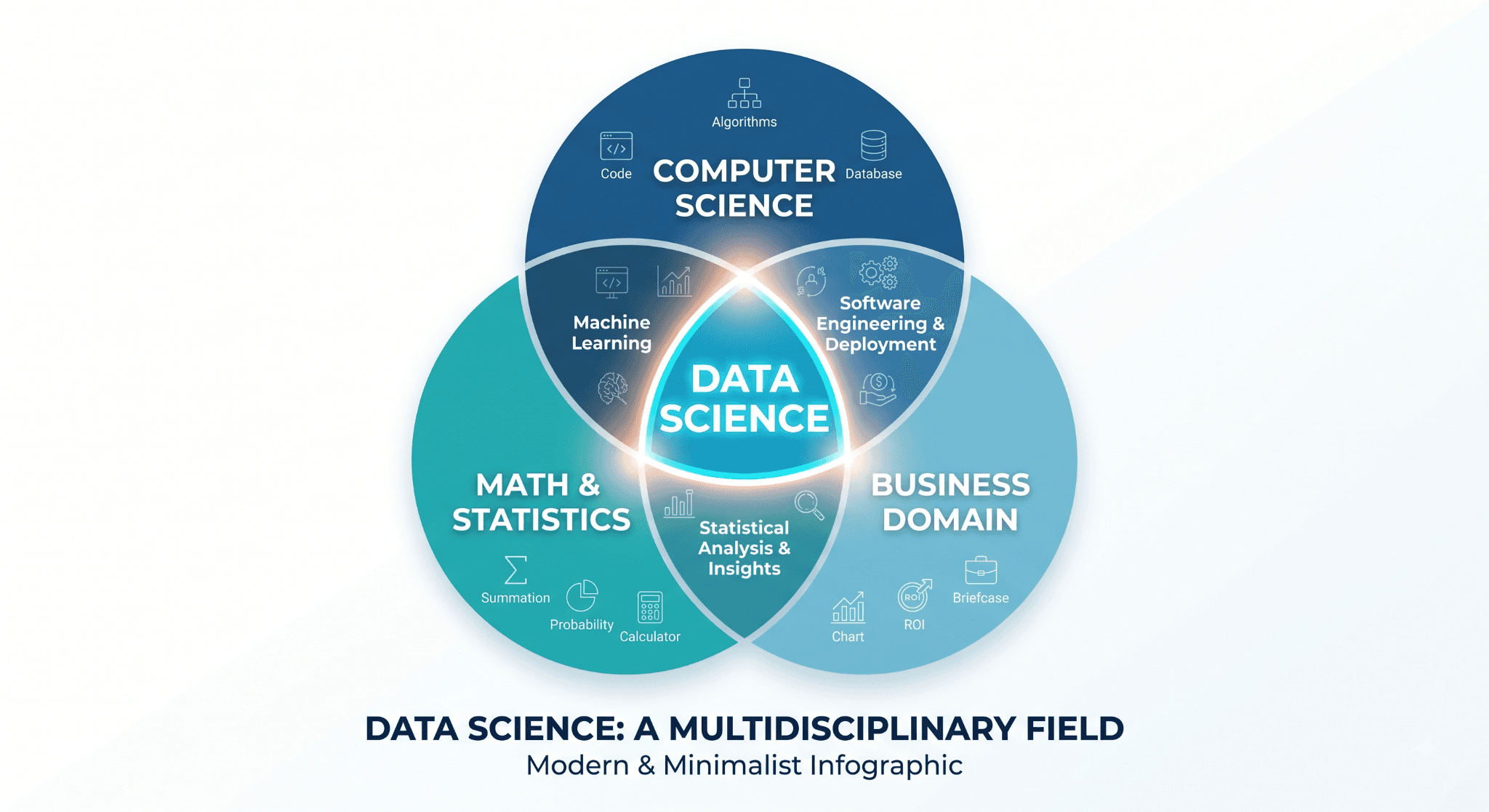
One of the best-kept secrets in the analytics industry is that non-IT students actually possess a massive hidden advantage: Domain Knowledge. True Data Science is a blend of coding, statistics, and business knowledge.
Data Science is not just about writing code; it is about solving business problems. Let's break down how your non-tech background is actually a superpower:
Mechanical, Civil & Core Engineers
Core engineers are rigorously trained in applied mathematics, thermodynamics, physics, and structural logic. You already know how to approach a physical problem systematically. In the corporate world, manufacturing companies, automotive giants, and supply chain firms need analysts who understand how physical machines work. If you build a machine learning model to predict when a factory machine will break down (predictive maintenance), your mechanical background makes you far more valuable than a pure software developer who doesn't understand machinery.

Commerce, Finance & BBA Graduates
If you come from a commerce or business background, you inherently understand economics, profitability, profit margins, and consumer behavior. Financial institutions, banks, and e-commerce startups desperately need data professionals who understand business metrics. A tech graduate might know how to build a beautiful chart, but a commerce graduate knows exactly what that chart means for the company’s bottom line.
Comparative Advantage Breakdown
Professional Background | Inherent Strengths | What They Must Learn | Target Industries |
Mechanical/Civil Engineers | Process logic, heavy mathematics, physical system understanding | Python scripting, SQL, Data Visualization | Manufacturing, Supply Chain, Automotive Tech |
Commerce & BBA | Financial forecasting, P&L understanding, market economics | Statistics, SQL, Tableau/PowerBI | BFSI (Banking), E-commerce, Retail Analytics |
B.Sc / M.Sc (Non-IT) | Research methodologies, hypothesis testing, scientific logic | Commercial tool sets, programming basics | Healthcare Analytics, Pharma, Biotech |
Your goal is not to become a core software developer. Your goal is to become a business problem solver armed with modern data tools.
Overcoming the Fear of Coding: Python vs. Spreadsheets
The biggest barrier for non-CS students is the psychological fear of coding. You might look at a screen full of code and feel entirely overwhelmed.
Here is the truth: Is coding required for Data Science? Yes. But you must understand that Data Science coding is vastly different from Software Engineering coding. Software engineers build complex systems. As a Data Scientist, you are writing scripts to analyze data. You are essentially using Python as a highly advanced calculator.
To put this in perspective, look at the transition from traditional Excel to Python for data analysis:
Action | Traditional Way (Excel) | Modern Data Science (Python/Pandas) | Advantage of Python |
Loading Data | Opening a 5MB |
| Can load 5+ Gigabytes of data in seconds without crashing. |
Filtering Rows | Clicking through drop-down menus manually. |
| Instantaneous; creates an exact, repeatable rule. |
Handling Missing Data | Scrolling through thousands of rows visually. |
| Replaces all missing values across a million rows instantly. |
Once you realize that coding in this field is just writing simple, logical instructions to a machine, the fear disappears. Structured learning environments like upGrad classes in Pune are specifically designed to teach Python step-by-step from absolute scratch.
Real Proof: The Career & Salary Trajectory
Let’s look at a realistic scenario playing out right now in Pune’s tech ecosystem. Meet Rahul, a recent Mechanical Engineering graduate. During his final semester, he realized that campus placements for core mechanical roles were offering a starting salary of ₹2.5 LPA with grueling factory shifts.
Instead of settling, Rahul decided to pivot. He enrolled in a structured Data Science program at the upGrad Learning Support Centre Pune designed specifically for non-IT freshers. He spent the first few weeks struggling to understand basic programming logic, but with hands-on guidance, he stayed consistent. By the fourth month, he was using Python to analyze massive datasets.
For his final project, he didn't build a generic app. Instead, he downloaded a massive public dataset on global supply chain logistics. He used his mechanical engineering logic to clean the data and built a Power BI dashboard showing how companies could reduce shipping delays by 15%.
During a placement drive supported by upGrad placement assistance in Pune, an analytics firm in Kharadi looked at his supply chain dashboard. They realized he understood both the physical logistics of the business and the technical code to analyze it. He was hired as a Junior Data Analyst with a starting package of ₹6.0 LPA.

Data Science jobs for freshers are rapidly opening up to anyone who can prove their practical competence, and the financial rewards outpace traditional engineering branches significantly.
The 90-Day Blueprint: Your Step-by-Step Transition
How do you actually make this transition? You do not need to go back to college for four years. You need a highly focused, 90-day action plan.
1. The Foundation (Excel & SQL) — Month 1
Do not start by trying to build Artificial Intelligence. Start with the basics. Master Advanced Excel (Pivot Tables, VLOOKUP) and SQL (Structured Query Language). Learn how to write SELECT statements, JOIN tables, and use aggregate functions. If you can master SQL, you are already qualified for entry-level data roles.
2. The Logic (Python & Pandas) — Month 2
Now, introduce programming. Learn Python variables, loops, and basic logic. Focus heavily on the Pandas Library, a specific tool inside Python used purely for data manipulation. Learn how to load a messy dataset, remove empty rows, and calculate averages.
3. The Storytelling (Visualization & Portfolio) — Month 3
Data is useless if you cannot explain it to a non-technical manager. Learn Power BI or Tableau to build interactive, colorful dashboards. Take three different datasets and build a complete dashboard for each. Publish these projects on a GitHub profile and share them on your LinkedIn.
Choosing the Right Launchpad
While you can learn a lot from free online tutorials, the fastest and most reliable way to transition is through structured, professional mentorship. Choosing the upGrad training centre in Pune gives you access to a supportive learning ecosystem designed to guide you from absolute zero to interview-ready.
When looking for Data Science training, the upGrad learning centre in Pune offers distinct advantages:
Curriculums designed for absolute beginners: Whether you study at upGrad Kothrud, Pune or another location, classes start from the absolute basics without assuming prior coding knowledge.
Heavy focus on SQL and Python: The upGrad institute in Pune emphasizes the foundational tools that form the backbone of the tech industry.
Capstone Projects: Build a practical portfolio of real-world projects to showcase to top recruiters.
Dedicated Placement Teams: Achieve your career goals with upGrad placement assistance in Pune, offering mock interviews, resume preparation, and direct hiring partner access.
The demand for analytical talent in 2026 is too massive for companies to restrict their hiring strictly to Computer Science graduates. They need smart, logical, hardworking individuals who can interpret data.
Whether you are studying mechanical engineering or commerce, your past does not dictate your future. Stop listening to the skeptics, connect with upGrad Pune, start learning SQL, and take the first step toward a high-paying, future-proof career today.
Frequently Asked Questions
Is Data Science suitable for freshers from non-IT backgrounds? Absolutely. As long as you are willing to learn logical problem-solving and basic programming, your non-IT background (like commerce or mechanical engineering) can actually serve as an advantage by providing unique domain knowledge.
How can freshers start a career in Data Science without a tech degree? The most effective path is to build a proof-of-work portfolio. Start by mastering SQL and Excel, move on to Python, and build 3-4 interactive data dashboards. Leverage the Data Science placement opportunities and upGrad placement assistance in Pune provided by top institutes to bypass traditional HR screening.
Will companies really hire me over a Computer Science graduate? Yes. In 2026, companies hire based on skills and portfolios, not just degree titles. If you can walk into an interview and demonstrate a functional machine learning model or a complex SQL query while the CS graduate cannot, you will get the job.