For many engineering graduates and IT freshers, getting the first job feels like the finish line.
After months of aptitude tests, coding rounds, interviews, and waiting for offer letters, the moment finally comes. You join the company with excitement, confidence, and a belief that college, certifications, or short-term preparation have made you ready.
Then reality begins.
In the first few weeks, many freshers quietly realize something unexpected: there is a gap between what they studied and what the job actually demands.
That gap is not a sign of failure. It is a very normal part of entering the IT industry. The real issue is that many students are never told why this happens or how to handle it properly. Understanding this early can make a huge difference in long-term career growth.
What Is a Learning Gap in the First Job?
A learning gap appears when a fresher knows the basics of a subject but struggles to apply that knowledge in a real work environment.
For example, a student may know Java syntax, SQL queries, software testing concepts, or web development basics. But in the workplace, they are suddenly expected to work with real codebases, follow team processes, understand business requirements, debug issues, write maintainable code, communicate updates, and learn tools quickly.
This is where many freshers feel stuck.
They are not completely unskilled. They are simply not yet trained in practical industry execution.
That difference matters.
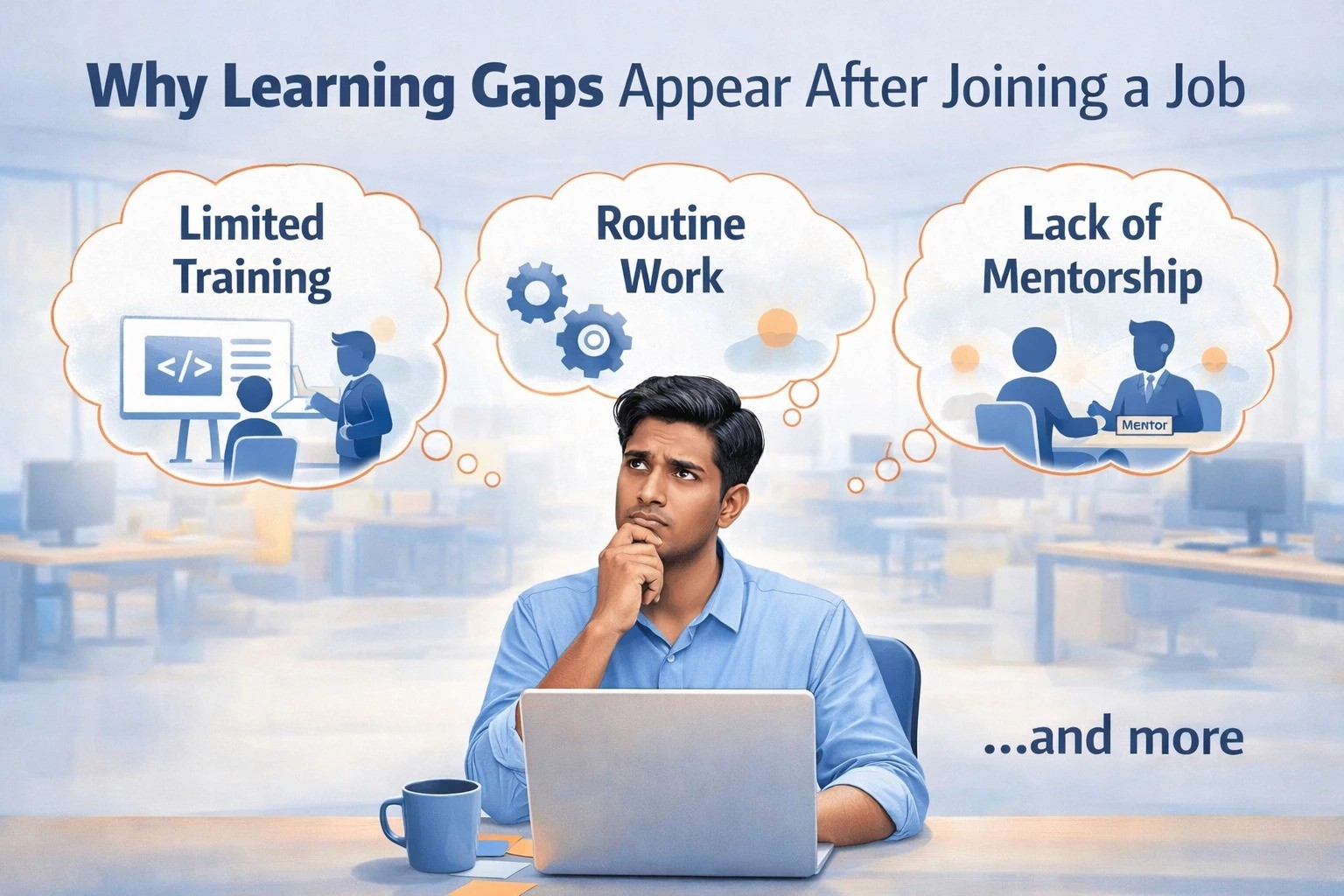
Why Learning Gaps Appear After Joining a Job
1. College Learning and Job Work Are Very Different
In many colleges, students learn theory, write exams, complete assignments, and build small academic projects. This helps create a foundation, but workplace learning is different.
In a real IT job, nobody asks only for definitions. Teams expect you to solve real problems. You may need to understand a ticket, check existing code, update logic carefully, test changes, and make sure nothing breaks in production.
This shift from “learning for marks” to “learning for delivery” creates the first major gap.
2. Real Projects Are More Complex Than Student Projects
A college project is usually small, controlled, and built for submission. A company project is bigger, more layered, and connected to business impact.
You may have multiple modules, shared databases, APIs, release cycles, bug tracking tools, approvals, and deadlines. Even reading the existing system can feel difficult in the beginning.
This is why many freshers who were confident during training feel overwhelmed during the first few months on the job.
3. Companies Expect Learning Speed, Not Just Existing Knowledge
Most entry-level hiring in IT is based on potential. Companies know freshers may not know everything on day one. But they do expect quick learning, adaptability, discipline, and consistency.
The challenge is that many students prepare only to get selected, not to keep learning after selection.
Once the job starts, the environment changes fast. New tools, domain knowledge, client expectations, and internal processes appear all at once. A fresher who stops learning after placement usually starts feeling the gap very quickly.
4. Communication and Teamwork Become Part of Performance
In college, technical knowledge is often evaluated separately. In a job, communication becomes part of the work itself.
You may have to explain your progress in stand-up meetings, ask for clarification, write emails, update task trackers, or discuss issues with seniors. Even good technical performers can struggle if they are not used to professional communication.
That creates another learning gap many freshers do not expect.
5. Freshers Often Learn Tools, But Not Workflows
A student may know programming languages, testing types, or database basics. But real work also involves learning how work moves in a team.
That includes understanding agile practices, task assignments, code reviews, version control, release processes, documentation, defect tracking, and quality checks.
This is why a fresher may say, “I know the technology, but I still feel confused in the job.”
The confusion is often not about knowledge alone. It is about workflow awareness.
Signs That You Are Facing a Learning Gap
Many freshers experience this silently. Some common signs include:
You understand theory but cannot complete assigned tasks independently
You need repeated help for simple work items
You feel lost when reading existing project code
You struggle to connect business requirements with technical implementation
You avoid asking questions because you fear sounding weak
You feel that others are learning faster than you
These signs are common in early career stages. The wrong response is to panic. The right response is to identify the gap clearly and work on it step by step.
How IT Freshers Can Close Learning Gaps Faster
Focus on Practical Learning, Not Passive Learning
Reading is useful, but job readiness grows faster through practice.
If you are weak in Java, testing, SQL, Python, frontend development, or any other area, build small working tasks around it. Practice debugging. Write code. Test it. Break it. Fix it. Repeat.
Practical exposure builds confidence much faster than only watching tutorials.

Strengthen Fundamentals Again
A common mistake is assuming fundamentals no longer matter after getting placed. In reality, fundamentals become more important in real projects.
If you are a software developer, strong basics in logic, programming, databases, APIs, data structures, and debugging help a lot. If you are in testing, understanding test scenarios, defect reporting, SDLC, and practical tool usage matters.
The stronger the basics, the smaller the learning gap feels.
Learn the Work Environment, Not Just the Technology
Spend time understanding how the team works. Observe task boards, meeting structures, deployment flow, coding standards, and review practices.
Freshers who learn the environment become productive faster than those who only focus on technical topics in isolation.
Build Industry-Oriented Projects
One of the best ways to reduce job shock is to work on projects that feel closer to real industry practice.
That means projects with proper structure, documentation, version control, modules, testing, and problem-solving thinking. This is also why skill-based training and practical project work matter so much in today’s hiring ecosystem.
Why Structured Learning Matters Before and After Placement
The truth is simple: getting a job is one stage; growing in the job is another.
Freshers who come from structured, practical, industry-oriented learning environments usually adapt faster because they have already been exposed to real workflows, project thinking, and skill-based execution.
This is exactly why students should not focus only on certifications or interview clearing strategies. They should focus on becoming work-ready.
Conclusion
Learning gaps after joining a job are real, common, and completely manageable.
They appear because college learning, interview preparation, and real IT work are not the same thing. The good news is that this gap can be closed with the right mindset: practical learning, stronger fundamentals, workplace awareness, better communication, and consistent skill-building.
For engineering graduates, IT freshers, and interns, the goal should not be just to get hired. The goal should be to become capable, confident, and valuable in a real work environment.
That is what creates long-term career growth in IT.