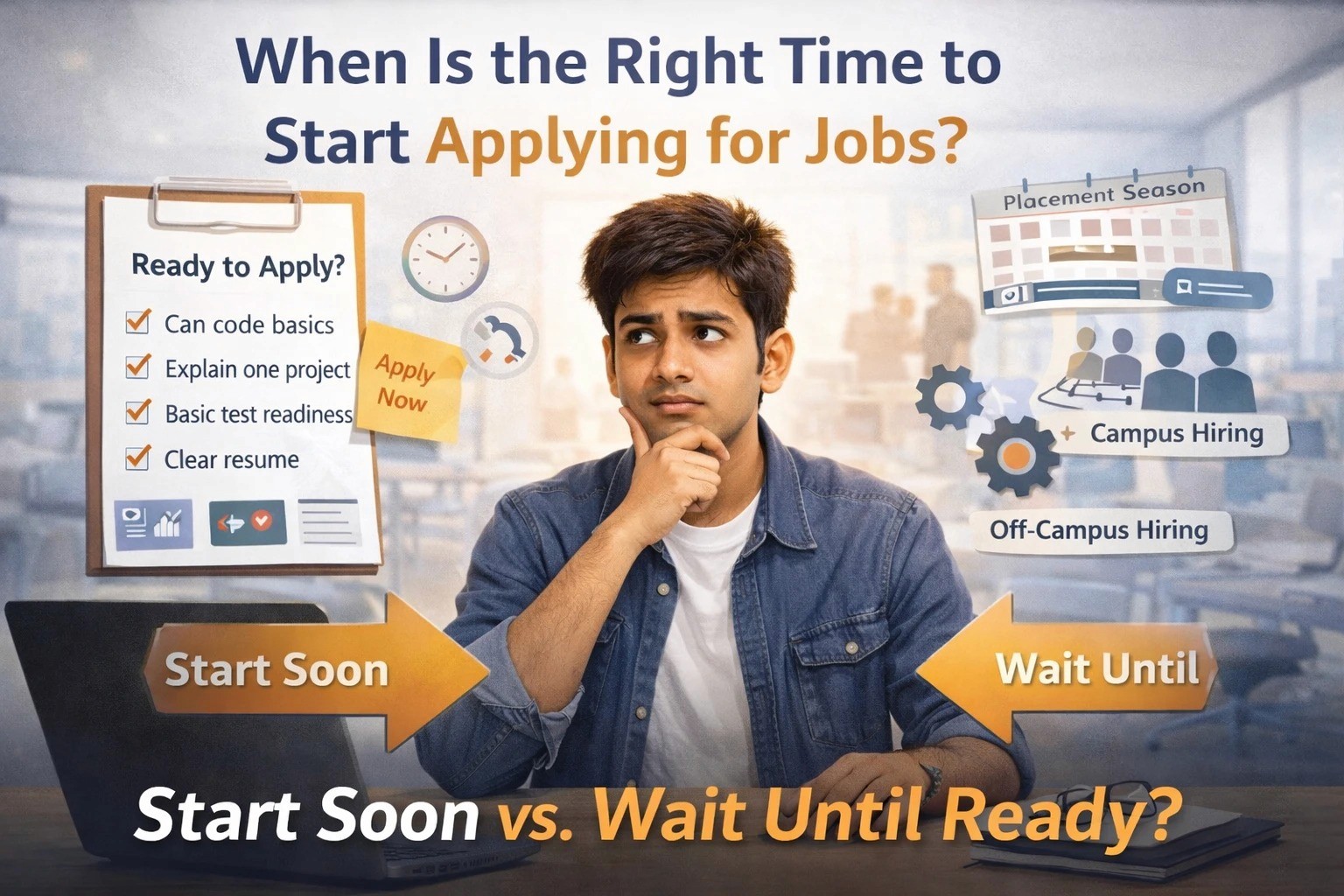
Introduction: The real confusion freshers face
One of the most common questions IT freshers ask is, “Should I start applying now or wait until I’m fully ready?” In today’s Indian IT job market, waiting for complete confidence often delays opportunities. Hiring has become skills-based, and readiness is built through a mix of learning, practice, and real interview exposure.
Reports like the India Skills Report show that employability is improving but competition remains high, which means companies filter candidates early through resumes, skill tests, and interviews. This makes timely applications important, not optional.
The biggest myth: “I must be 100% ready before applying”
This is the most harmful misconception. In reality, preparation and applications should run in parallel. Interviews themselves act as feedback loops. They help you understand:
what companies actually test,
how well you explain your skills,
where your real gaps are.
Most freshers who secure jobs did not feel “fully ready” when they started applying.
A simple checklist: Are you ready to apply?
You are ready to start applying if you meet most of the points below.
• Basics are usable, not perfect
You can write small programs using loops, conditions, functions, arrays/strings, and fix simple errors without constant help.
• At least one explainable project
You can clearly explain:
the problem,
how your project works (input → process → output),
what you built,
one or two challenges you faced.
• Basic test readiness
You can attempt aptitude questions or easy coding problems under time limits, even if you don’t get everything right.
• Resume is honest and clear
Your resume matches what you can actually explain. No exaggerated skills.
If you meet 70–80% of this list, don’t wait—start applying.
When to apply: Practical timelines for freshers
Final-year students (campus hiring):
Start applying as soon as placement season begins. Early rounds usually focus on aptitude, basics, and communication—areas you improve through practice, not delay.
Passed-out freshers (off-campus):
Start applying once you have:
one focused resume,
one solid project,
a daily practice routine (2–3 hours).
Waiting longer rarely improves outcomes.
Service companies vs product companies
Service companies:
You can apply earlier. They usually test aptitude, basic coding, and communication. Consistency matters more than depth.
Product companies/startups:
Apply when you can solve easy-to-medium problems and explain projects with clarity. You don’t need to know everything—just show structured thinking.
How to apply while preparing (smart approach)
Don’t separate preparation and applications.
Daily approach:
1–1.5 hours: skill practice (coding/aptitude)
30–45 minutes: project improvement or revision
20–30 minutes: job applications
10 minutes: review mistakes and gaps
This balanced routine builds confidence faster than waiting silently.
Signs you are delaying unnecessarily
If you often say:
“I’ll apply after finishing the full course.”
“I’ll apply after mastering all topics.”
“I’ll apply once I feel confident.”
…you are likely postponing growth. Confidence usually comes after interviews, not before them.