
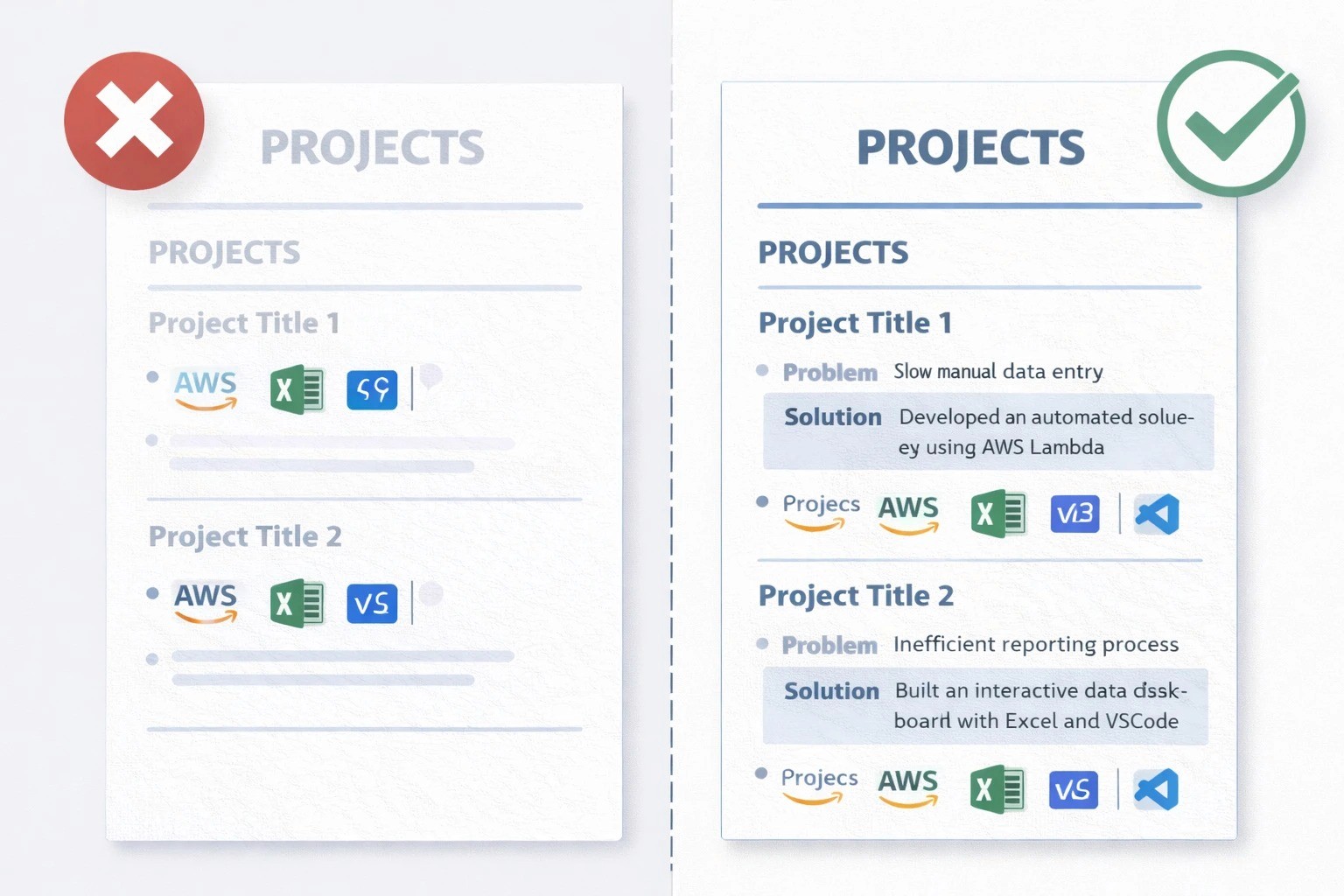
Project descriptions are often the most important section of a fresher’s resume. Yet, they are also the most poorly written. Recruiters don’t expect freshers to build complex systems.
But they do expect clarity, honesty, and basic understanding.
Unfortunately, many resumes get rejected—not because projects are weak, but because they are described badly.
Let’s look at the most common mistakes freshers make while writing project descriptions, and why they hurt your chances.
1. Writing Vague and Generic Project Titles
Many fresher resumes mention projects like:
College Management System
Online Shopping Project
Banking Application
Final Year Project
These titles tell the recruiter nothing specific. Recruiters immediately wonder:“What exactly did you build here?”
If the title sounds copied or generic, they move on quickly.
Better approach: Be specific and descriptive.
“Student Attendance Tracker using Python and MySQL”
“REST-Based E-Commerce Backend using Java and Spring Boot”
Why this matters: Clear titles create curiosity and trust.
2. Not Explaining the Problem the Project Solves
Many project descriptions jump straight into tools: “Used Java, SQL, HTML, CSS…”
But recruiters first want to know:
What problem did this project solve?
Why was it needed?
Without context, the project feels meaningless.
Reality: Projects are evaluated on problem understanding, not just technology.
3. Listing Tools Without Showing Usage
This is one of the biggest mistakes.
Example: “Technologies used: Python, Django, MySQL, AWS”
But there is no explanation of:
What Django was used for
How MySQL was designed
What AWS service was involved
Recruiters see this daily—and they don’t trust it.
Better approach: Briefly explain how you used each tool.
4. Copy-Pasting Academic or Internet Language
Phrases like:
“This project is very useful in today’s digital world”
“It helps to reduce manual work”
“The system is efficient and user-friendly
These lines appear in thousands of resumes. Recruiters instantly recognize copy-paste content.
Reality: Generic language makes your project look fake—even if it’s real.
5. Not Mentioning Your Individual Contribution
In group projects, freshers often write: “We developed a system…”
Recruiters then ask: “What did you actually do?”
If your role is unclear, your contribution is assumed to be minimal.
Better approach: Clearly mention your responsibility:
Backend logic
Database design
API development
Testing
UI implementation
6. Writing Long Paragraphs Instead of Scannable Points
Recruiters don’t read project descriptions word by word. They just scan and here long paragraphs fail in 6–7 seconds of resume scanning.
Better approach:
Use 3–4 crisp bullet points:
Problem statement
Your role
Key functionality
Tools used
7. No Proof That the Project Actually Works
Many project descriptions lack:
GitHub links
Screenshots
Deployment mention
Demo explanation
Without proof, recruiters can’t verify your work.
Reality: If there’s no evidence, the project feels theoretical.
8. Overclaiming or Exaggerating Skills
Freshers sometimes claim:
“Designed complete architecture”
“Handled deployment independently”
“Built scalable enterprise solution”
Recruiters know what is realistic for a fresher. Overclaiming damages credibility.
Reality: Honest, well-explained small projects are valued more than exaggerated ones.
9. Projects Not Matching the Target Job Role
A resume applying for QA roles but showing only: Frontend UI projects
Or a data role resume with: Only HTML/CSS projects
This creates confusion.
Reality: Projects must align with the job role you’re applying for.
10. Treating Projects as Academic Formalities
Many freshers write projects as if they were:
Exam answers
College submissions
Recruiters look at projects as work samples, not marksheets.
Projects should sound like real work, not coursework.
How to Write Better Project Descriptions (Simple Formula)
Use this structure:
What problem did you solve?
What exactly did you build?
What was your role?
Which tools did you use and why?
Where can it be seen (GitHub / demo)?
This alone can dramatically improve shortlisting chances.

