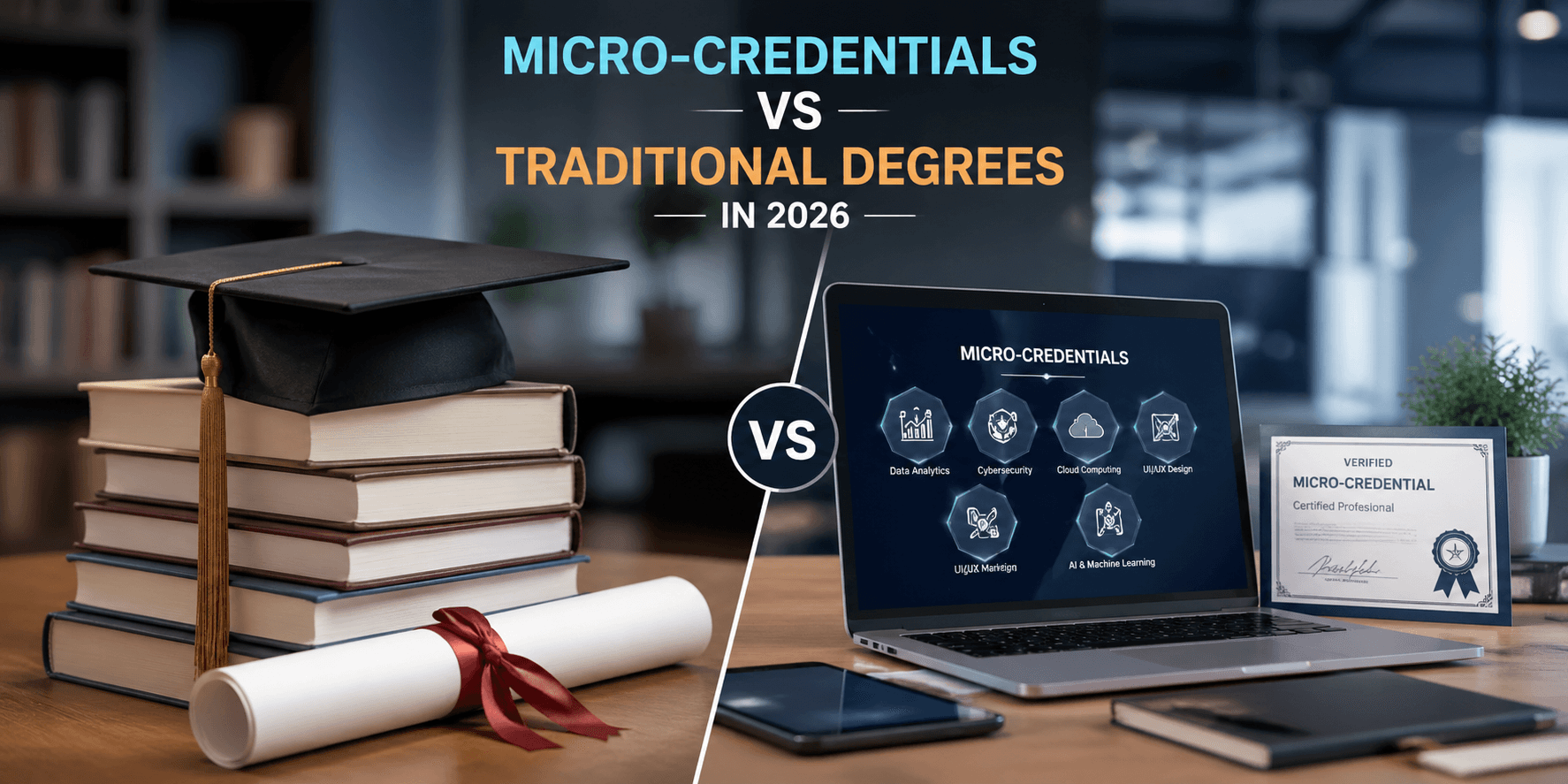
The IT job market in India is evolving rapidly. With the rise of online certifications, short-term courses, and skill-based programs, many freshers are confused:
Are traditional degrees still important, or are micro-credentials enough to get hired in 2026?
The answer is not either-or. Both play different roles in shaping a fresher’s career.
What Are Traditional Degrees?
Traditional degrees refer to structured academic programs such as B.E., B.Tech, BCA, MCA, or similar qualifications. These programs provide:
Foundational technical knowledge
Structured curriculum
Exposure to theoretical concepts
Recognized academic credibility
In India, many IT companies still require a graduation degree as a basic eligibility criterion, especially in campus placements and bulk hiring drives. A degree acts as a minimum qualification benchmark.
However, a degree alone does not guarantee job readiness.
What Are Micro-Credentials?
Micro-credentials are short-term certifications or skill-based programs that focus on specific competencies. Examples include:
Cloud certifications
Data analytics certifications
DevOps tool training
Cybersecurity modules
Project-based bootcamps
These programs are designed to build practical, job-oriented skills within a shorter time frame. They are flexible and often aligned with current industry demand.
Micro-credentials demonstrate that a candidate has invested effort in learning specific tools or technologies beyond college syllabus.
Why Micro-Credentials Are Growing in 2026
The IT industry changes faster than university syllabi. Many colleges update curriculum slowly, while technologies evolve quickly. Micro-credentials help bridge this gap by:
Teaching in-demand tools
Providing hands-on exposure
Focusing on real-world projects
Offering faster upskilling
Companies are increasingly valuing practical competence, especially in emerging domains like AI, cloud computing, and automation.
Limitations of Each Path
A traditional degree provides long-term academic foundation but may lack practical exposure if not supplemented with projects.
Micro-credentials offer focused skill learning but may lack depth if fundamentals are weak.
Relying only on certifications without understanding core concepts can create shallow knowledge. Similarly, relying only on a degree without practical skills can reduce employability.
What Do IT Companies in India Actually Value?
In 2026, most Indian IT companies look for:
A valid graduation degree (basic eligibility)
Strong fundamentals
Demonstrable practical skills
Ability to adapt and learn
Clear communication
Degrees help you enter the process. Skills help you clear it.
The Smart Strategy for Freshers
Instead of choosing one over the other, freshers should combine both:
Complete your degree with strong conceptual clarity
Add 1–2 industry-relevant micro-credentials
Build real projects
Practice problem-solving regularly
This balanced approach increases both credibility and capability.
Conclusion
Micro-credentials are rising because the industry values practical skills. Traditional degrees remain important because they provide foundational knowledge and eligibility.
In 2026, success in the Indian IT job market depends on combining academic qualification with measurable skill development.