
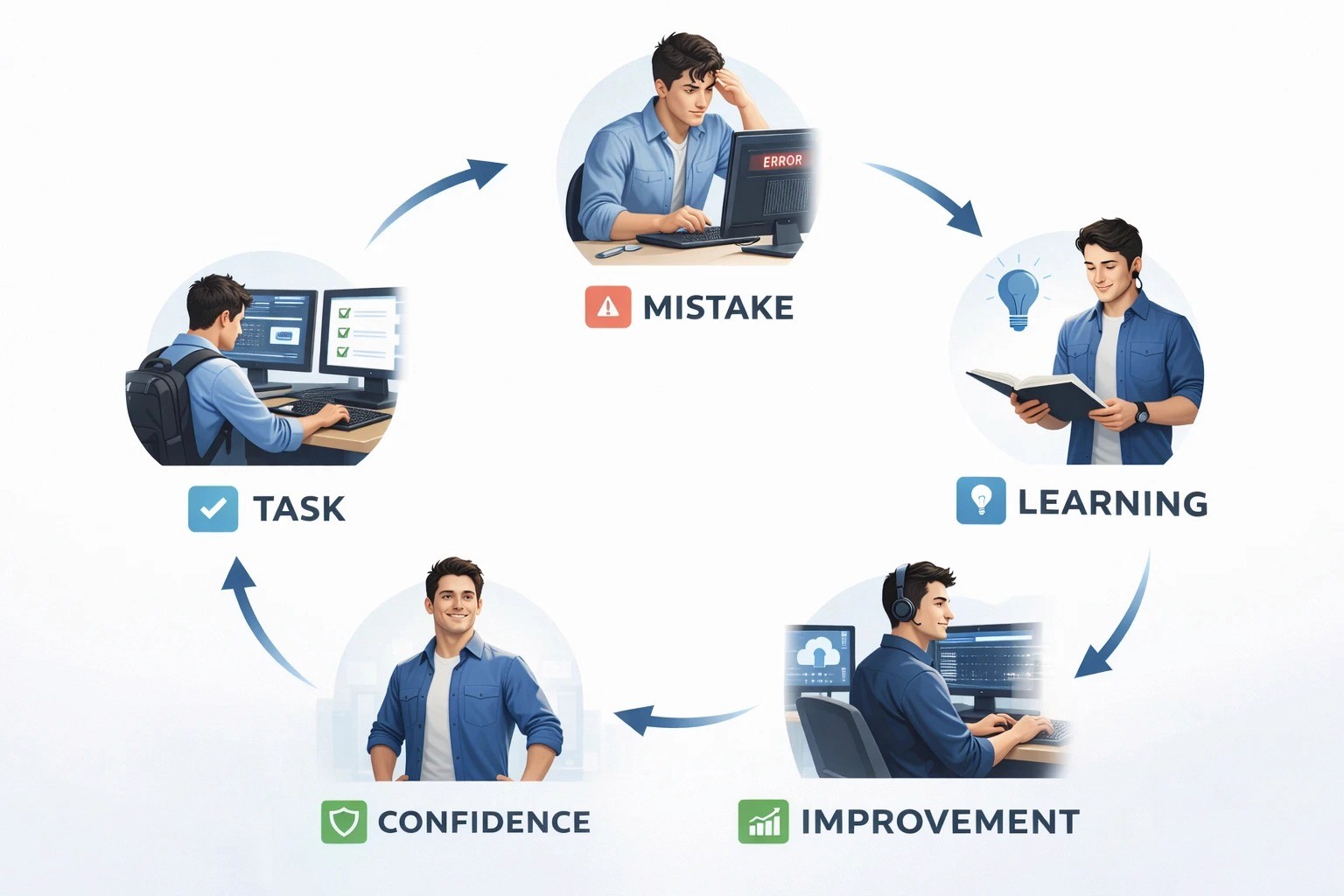
For most freshers, the real learning starts after joining the first IT job. College gives theory, Training gives direction but on-the-job learning is what actually builds confidence, speed, and career growth.
Freshers who understand how to learn at work grow much faster than others—even if they start with average skills.
Why On-the-Job Learning Matters More Than Anything Else
In the Indian IT industry, companies do not expect freshers to know everything.
They expect freshers to:
Learn quickly
Adapt to systems
Improve with experience
Real projects involve:
Large codebases
Live data
Deadlines
Team coordination
These cannot be fully learned from books or courses alone.
1. Learn by Observing Before Acting
Fast-growing freshers spend their first few months watching carefully:
How seniors debug issues
How tickets are analyzed
How meetings are handled
How production problems are fixed
They don’t rush to “prove” themselves immediately.
Smart habit:
Observe patterns. Note how decisions are made. Then apply the same approach in your tasks.
2. Ask the Right Questions (Not Too Many, Not Zero)
Freshers who grow fast ask quality questions, not random ones.
Bad habit:
Asking without trying
Asking the same doubt repeatedly
Good habit:
Try first
Note what you tried
Ask specific questions
Managers appreciate freshers who show effort before asking.
3. Treat Every Task as a Learning Opportunity
Some tasks may feel boring:
Bug fixing
Data cleanup
Support tickets
Documentation
But these tasks teach:
System understanding
Edge cases
Real-world problems
Freshers who take ownership of “small” tasks often get bigger responsibilities sooner.
4. Learn the System, Not Just Your Module
Many freshers limit themselves to: “This is my part. That’s not my responsibility.”
This slows growth.
Fast learners try to understand:
How data flows end-to-end
How different teams connect
How a change impacts other modules
This makes you valuable—not just skilled.
5. Make Mistakes, But Never Repeat the Same One
Mistakes are expected from freshers. Repeating the same mistake is not.
Best practice:
Maintain a personal notes file
Write down errors and fixes
Document learnings after each task
This habit alone can double your growth speed.
6. Learn Beyond Office Hours (But Be Smart)
On-the-job learning works best when combined with self-learning. You don’t need to study all night. Even 30–60 minutes daily is enough.
Focus on:
Basics related to your current role
Tools used in your project
Common interview-level concepts
7. Learn Communication Along With Technical Skills
Fast-growing freshers also learn:
How to explain problems clearly
How to update status professionally
How to write clean documentation
These skills improve visibility and trust—often leading to faster appraisals and better roles.
8. Find a Mentor (Official or Unofficial)
A mentor doesn’t have to be assigned.
It can be:
A senior teammate
A friendly lead
Someone whose work you admire
Observe them. Learn how they think. Ask for feedback occasionally.
Final Thoughts
Freshers who grow fast are not the smartest—they are the most adaptable.
They:
Learn from real work
Stay curious
Accept feedback
Improve every month
Your first IT job is a training ground. If you learn the right way, it can set up your entire career.


