
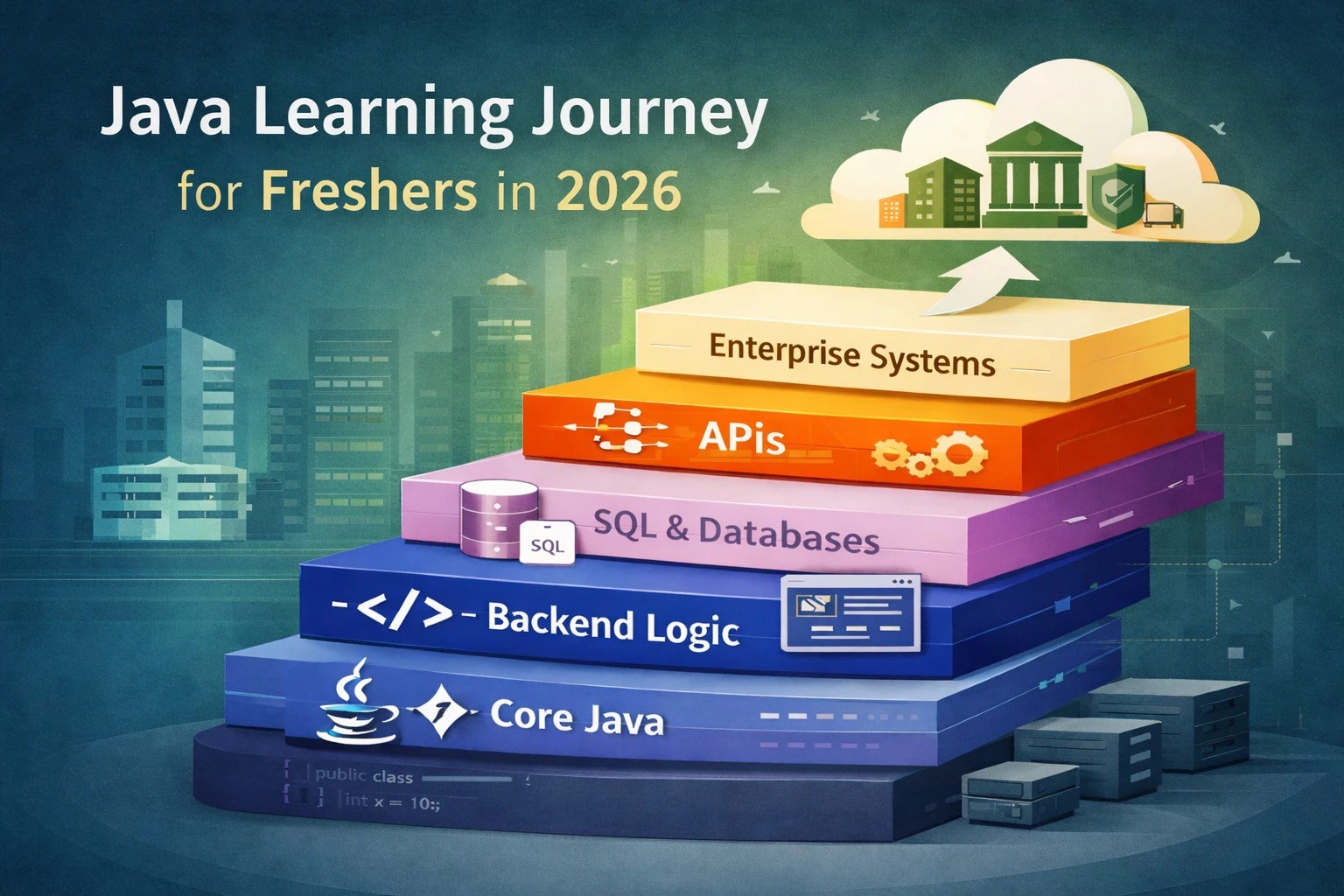
Java in 2026: Is It Still Worth Learning for Freshers?
For many engineering freshers in India, Java is often the first programming language they hear about when thinking of an IT career. It has been part of college curriculum for years and is widely used in enterprise software. But with new languages, AI tools, and changing hiring patterns, a common question arises in 2026: Is Java still worth learning for freshers?
The reply is yes - but with the right expectations. Java is no longer a “shortcut” to a job, but it remains a reliable and relevant skill for backend and enterprise roles. This article explains the reality of Java in 2026, what companies actually expect from freshers, and the common mistakes to avoid.
Why does Java still help freshers in India’s IT placements?
Java continues to be one of the most widely used programming languages in the world, especially in enterprise, backend, and large-scale systems. In India, this is particularly important because:
IT services companies use Java extensively for client projects in banking, insurance, telecom, healthcare, and government systems
Product companies and startups rely on Java-based frameworks for scalable backend systems
Many legacy systems, which still power real businesses, are written in Java and require ongoing development and maintenance
These systems cannot be replaced overnight. As a result, companies consistently need Java developers who understand backend fundamentals, not just new tools.
What Java Roles Look Like for Freshers in 2026
For fresh graduates, Java-related roles are usually backend-focused, such as:
Java Developer (Entry Level)
Backend Developer (Java)
Software Engineer – Java
Application Support / Maintenance Developer
These roles are not about building flashy apps. Instead, they focus on:
Writing clean, structured backend code
Understanding how applications work behind the scenes
Handling data, business logic, and APIs
Working within large, existing codebases
This is why Java is still preferred—it encourages structured thinking, strong fundamentals, and disciplined coding practices.
What Companies Actually Expect from Java Freshers
A common misunderstanding among freshers is that knowing “Java basics” is enough. In reality, recruiters expect practical readiness, not just theoretical knowledge.
In 2026, companies hiring Java freshers typically look for:
1. Strong Core Java Fundamentals
Freshers should clearly understand:
Object-Oriented Programming (OOP) concepts
Classes, objects, inheritance, interfaces
Exception handling and collections
Basic multithreading concepts (conceptual level)
This matters because backend systems are built using these concepts every day.
2. Basic Backend Development Knowledge
Companies expect freshers to understand:
How a backend application works
Request–response flow
Simple REST APIs
How Java interacts with databases
You are not expected to design complex systems, but you should understand how real applications are structured.
3. Database and SQL Basics
Almost every Java backend role involves databases. Freshers should be comfortable with:
Writing basic SQL queries
Understanding tables and relationships
Performing simple CRUD operations
Many interviews reject candidates who ignore SQL, even if their Java basics are good.
4. Familiarity with Tools and Work Practices
Entry-level Java roles often require:
Basic Git usage
Working with IDEs like IntelliJ or Eclipse
Understanding how teams collaborate on code
These show that you can fit into a real development team.
Is Java “Too Old” or “Outdated”?
This is one of the biggest myths among freshers.
Java is not outdated. It continues to evolve with regular updates and is widely used in:
Enterprise applications
Backend services
Cloud-based systems
Financial and large-scale platforms
What has changed is how Java is learned and used. Companies no longer hire freshers just because Java is on their resume. They hire those who can apply Java to solve real problems.
Mistakes that hold freshers back in Java
Many freshers struggle with Java not because the language is irrelevant, but because of how they prepare.
Here are the most common mistakes:
1. Learning Only Theory
Memorizing definitions without coding regularly leads to poor interview performance.
2. Ignoring Backend Context
Learning Java syntax without understanding how applications work in real life limits job readiness.
3. Skipping SQL and Databases
Many freshers focus only on Java and forget that backend roles are incomplete without database knowledge.
4. Jumping to Advanced Topics Too Early
Trying to learn everything at once—frameworks, cloud, advanced concepts—without mastering basics leads to confusion.
5. No Practical Projects
Recruiters value what you have built, not how many tutorials you watched.
How Freshers Should Learn Java in 2026 (Realistic Approach)
To make Java worth learning, freshers should follow a structured and practical approach:
Master Core Java basics with daily coding practice
Learn OOP concepts deeply, not just definitions
Practice SQL alongside Java
Build simple backend projects, such as:
Student management system
Employee CRUD application
Simple REST-based backend service
Learn how to read and understand existing code
Practice explaining your logic clearly (important in interviews)
This approach matches what recruiters actually test during campus and entry-level hiring.
Java vs “Trendy” Technologies: A Reality Check
Some freshers worry that Java is not “trendy” compared to newer technologies. But hiring decisions are rarely based on trends alone.
Companies ask a simple question: Can this candidate contribute to our existing systems?
Java continues to score well here because:
It is stable and predictable
It enforces good coding discipline
It scales well for large applications
For freshers, stability matters more than hype.
Final Verdict: Is Java Worth Learning for Freshers in 2026?
Yes, Java is absolutely worth learning in 2026—if your goal is to build a long-term backend or enterprise IT career.
However, Java is no longer a “just learn and get hired” language. It rewards:
Strong fundamentals
Practical application
Consistent effort
For Indian IT freshers, Java remains one of the safest and most respected entry-level backend skills, especially for service-based and enterprise-focused companies.
Conclusion
If you are a fresher wondering whether to choose Java:
Choose it for fundamentals, not shortcuts
Focus on doing, not just learning
Build real projects, even small ones
Be patient—Java careers grow steadily
Java is not about quick success. It is about strong foundations and long-term growth. And in 2026, companies still value exactly that


