In Indian fresher interviews—campus or off-campus—your project discussion is often the most important part of the technical round. Why? Because projects are the closest “work sample” you can show when you don’t have full-time experience. Recruiters increasingly use skills-based hiring, and they look for candidates who can clearly articulate what they’ve done and how it relates to the job.
This is true across service companies (where they check basics + communication) and product companies/startups (where they check problem-solving + ownership).
Why recruiters focus on projects
Recruiters use your project to judge a few things very quickly:
Can you build something that works? A portfolio/project shows proof of skills beyond marks.
Do you understand what you wrote? They test depth: logic, data flow, edge cases, and debugging.
Can you explain your thinking clearly? Communication is part of engineering interviews, not an extra.
Do you take ownership? Even in a team project, they want to know your real contribution.
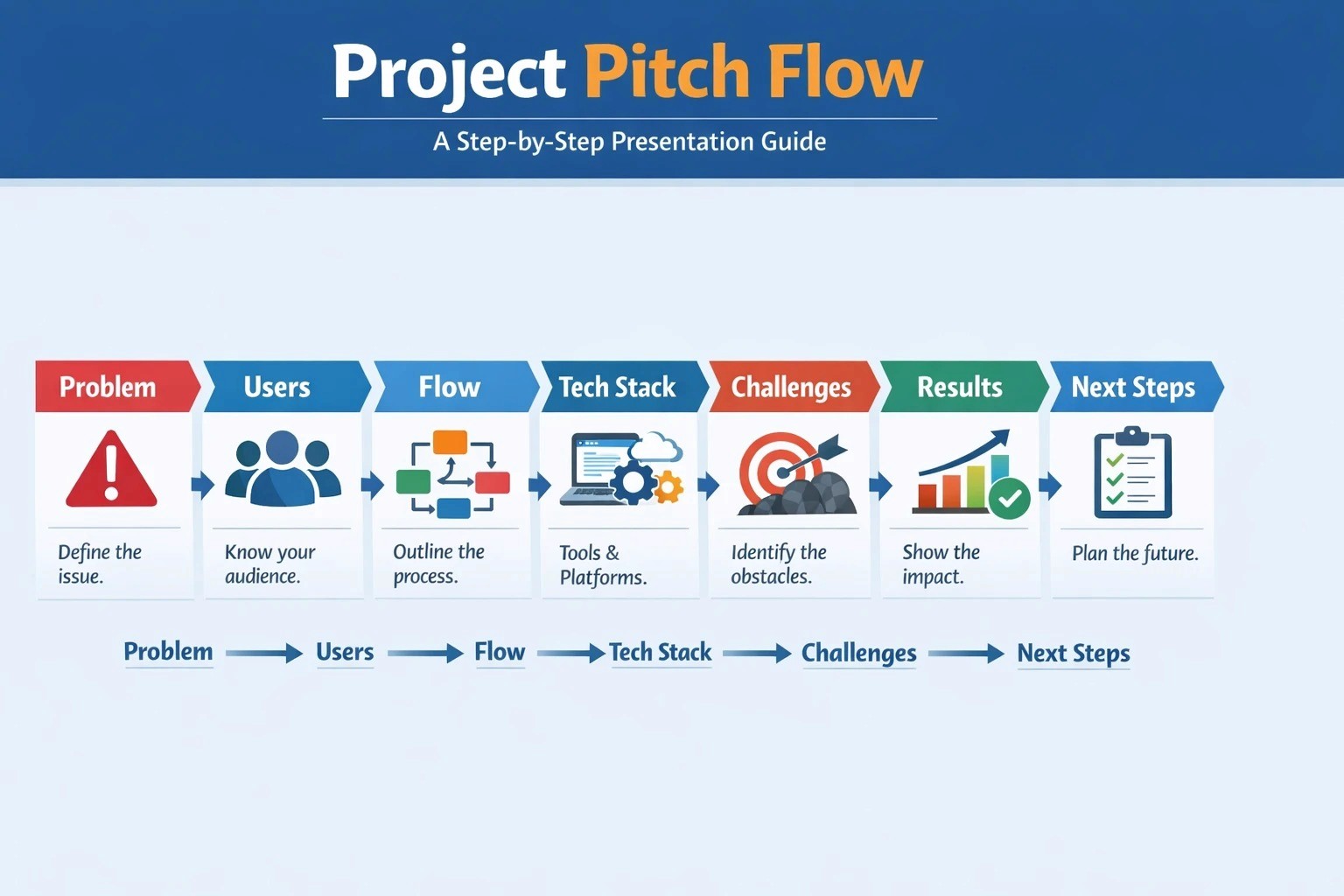
The best way to explain a project (step-by-step)

Use this structure. It works for both service and product interviews because it is simple and complete.
Step 1: Start with a 20–30 second overview
Say the project name + what it does + who it helps. Keep it plain and specific.
Example:
“I built a placement preparation web app that lets students practice coding questions, track scores, and get topic-wise reports.”
Step 2: Explain the problem and why it matters
Recruiters listen for clarity here. Mention the real pain point, not a generic sentence.
Pointer:
What issue did you notice?
What would happen without this solution?
Step 3: Show the flow (inputs → processing → output)
This is where you sound professional without using heavy words.
Pointer:
What data comes in?
What logic happens in the middle?
What is the output/user result?
Step 4: Mention tech stack only after the flow
Freshers often start with “I used React, Node…” too early. First explain what it does, then mention tools.
Pointer (keep it short):
Frontend: ___
Backend/API: ___
Database: ___
Hosting/Deployment: ___
Step 5: Share 1–2 key decisions and trade-offs
Good interviews test how you think, not just what you used. Even simple trade-offs are enough.
Example decisions:
“I used JWT for auth because it works well for stateless APIs.”
“I stored logs in MongoDB for quick search, but I know for scale we can move to ELK.”
(For technical interviews, explaining your approach and trade-offs is a common expectation.)
Step 6: Talk about challenges and how you fixed them
This is your strongest proof of real work.
Pointer:
What broke?
How did you debug?
What did you change?
Step 7: End with results + what you’d improve next

Even if it’s a college project, show outcomes.
Pointer:
Output/impact (faster, easier, fewer errors, clearer reports)
Next improvement (security, performance, UI, testing, scaling)
Common mistakes freshers should avoid
These mistakes reduce trust fast:
Speaking only about tools, not the problem and flow
Saying “we did it” without explaining your part
Copy-paste projects with no real understanding (interviewers detect this quickly)
Not knowing basics: database tables/collections, API endpoints, validations
No testing story (even basic test cases matter
How to prepare (simple checklist)
Do this the day before interviews:
Write a 60-second project script (overview + problem + flow + your role)
Make a feature list: top 5 features you built
Prepare 2 debugging stories (real errors you fixed)
Note 3 trade-offs (even small ones)
Keep your GitHub/README clean so you can show proof if asked
Practice explaining in simple language—no heavy terms
Final takeaway
A strong project explanation is not about speaking fancy English. It is about clarity, honesty, and structure. In a skills-based hiring market, freshers who can show real work and explain it well stand out—even with simple projects.