Introduction
In campus and off-campus hiring, thousands of freshers can apply for the same role. Companies need a way to compare candidates using the same yardstick. That’s where proctored tests help. They don’t guarantee a perfect hiring decision, but they reduce unfair advantages in online assessments and increase confidence that the score reflects the candidate’s own work.
What is a proctored assessment?
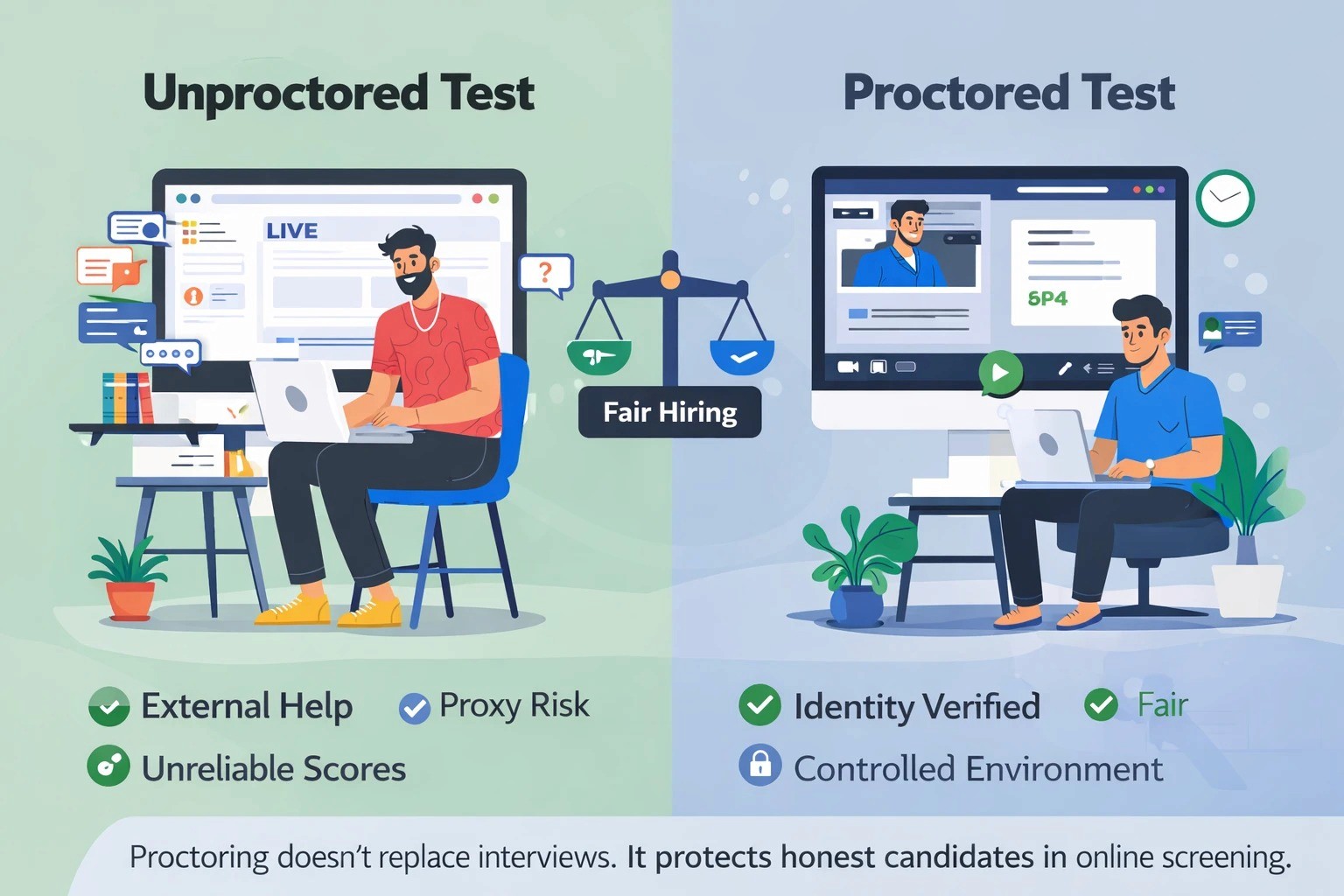
A proctored assessment is an online test that is monitored to maintain exam integrity—usually through a mix of identity checks and test-session monitoring (webcam, microphone, screen recording/sharing, secure browser, and event logs). Depending on the platform, proctoring can be live (human invigilator), recorded (review later), or AI-assisted/automated.
Why is proctored testing important for fair hiring?
1) It reduces cheating and score inflation
Research on online proctoring shows that when proctoring is introduced, average exam performance often drops—consistent with reduced misconduct and “inflated” scores in unproctored settings.
A broader research review also highlights that cheating is a known challenge in online exams and is a key reason institutions add prevention and detection measures.

2) It improves trust in online screening
For hiring teams, the first round is about filtering fairly at scale. Proctoring helps protect the credibility of online scores—so genuine candidates don’t lose out to unfair practices. Studies also link proctoring with improved perceived legitimacy of online exams.
3) It supports consistent evaluation across locations
In India, candidates may take tests from different colleges, cities, and home setups. Proctored workflows (ID verification + monitoring + logs) make results more comparable than completely unmonitored tests.
4) It protects honest candidates
Freshers who prepare properly often feel frustrated when they suspect others are using unfair shortcuts. A well-designed proctored test signals: “We’re serious about fairness.”
Important reality-check: Proctoring reduces risk; it does not eliminate it. Some organisations have reported that remote testing can become harder to police as cheating methods evolve, which is why proctoring must be combined with good test design and follow-up rounds.
Essential steps to implement proctored tests (practical and responsible)
Step 1: Define what “fair” means for your role
Start with skills you truly need (basic coding, debugging, SQL, aptitude, communication). Avoid tests that reward memorisation.
Step 2: Choose the right proctoring level
Recorded + AI flags for early screening
Live proctoring for high-stakes rounds
Secure browser for strict control (where appropriate)
Step 3: Keep candidate privacy and consent clear
Proctoring involves sensitive data (video/audio/screen). Use transparent notices, clear consent, data minimisation, and controlled access.
Step 4: Build “anti-cheat” into the test design
Proctoring is stronger when paired with:
Question randomisation
Time-boxed sections
Practical tasks (small coding + reasoning)
Follow-up interviews based on the candidate’s own solution (harder to fake)

Step 5: Reduce false flags and bias
AI can flag suspicious behaviour, but it can also misread normal actions. Keep a human review process for borderline cases.
Step 6: Run a candidate-friendly system check
Many freshers face issues like webcam permissions, bandwidth drops, or noisy environments. Provide:
Device checklist + sample test
Clear do’s/don’ts
Support channel during the test
Conclusion
Proctored tests improve fair hiring by increasing the chance that an online score reflects a candidate’s real skill—especially in large fresher intakes. When implemented responsibly (privacy + transparency + good test design), proctoring protects honest candidates and helps companies shortlist with more confidence.
FAQs
1) Are proctored tests only for big companies?
No. Any company hiring at scale can use proctored assessments—especially for early screening—using recorded or AI-assisted proctoring.
2) What do proctored tests usually monitor?
Common methods include identity verification, webcam/mic monitoring, screen capture/sharing, secure browser restrictions, and session logs.
3) Do proctored tests guarantee zero cheating?
No. They reduce cheating risk but don’t remove it completely. Good test design + follow-up technical discussion are still important.
4) Are there privacy concerns with online proctoring?
Yes. That’s why organisations should use clear consent, data minimisation, strict access controls, and defined retention periods.
5) How should freshers prepare for a proctored test?
Test your device setup early, practise solving problems without switching tabs, and focus on fundamentals + hands-on coding. (Proctoring is designed to reward genuine preparation.)