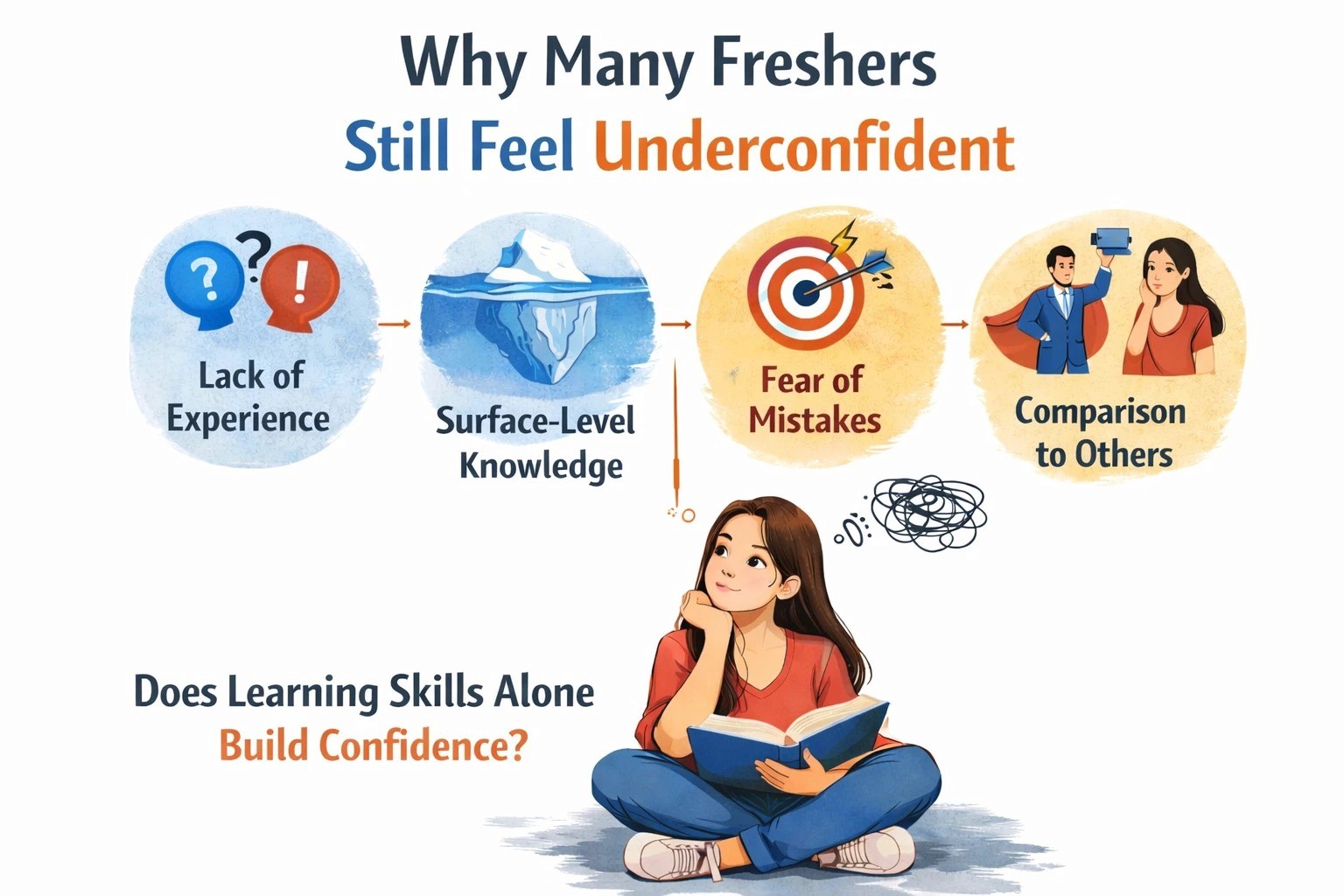
Many IT freshers say the same thing: Even after learning new skills everyday they don't feel confident. This feeling is common—and it doesn’t mean your effort is wasted. It usually means there’s a gap between learning and application, not a lack of ability.
Learning Creates Knowledge. Confidence comes from practice.
Watching tutorials, completing courses, or reading documentation builds understanding. But confidence only grows when you use that knowledge without guidance.
If most of your learning is passive, your brain hasn’t yet built trust in your own ability to handle problems independently. That’s why confidence feels low even when skills are improving.

Freshers Often Learn Without Feedback
In real jobs, confidence grows through feedback—code reviews, discussions, fixes, and corrections. Freshers usually learn alone, without knowing if they are “doing it right.”
Without feedback, it’s easy to doubt yourself, even when your solution is correct.
Comparison Makes Confidence Worse
Many freshers compare their learning journey with others:
who finished more courses
who got placed earlier
who sound more confident
What you see is output, not struggle. This comparison creates unnecessary pressure and hides your own progress.
Interviews Demand Explanation, Not Just Answers
You might understand a concept but struggle to explain it clearly under pressure. When that happens, it feels like a lack of confidence—but it’s actually lack of practice in articulation.
Confidence increases when you regularly practise:
explaining your thinking
speaking through problems
handling “I don’t know” calmly
Fear of Being Wrong Blocks Confidence
Many freshers believe confidence means being correct all the time. It doesn’t. Real confidence is the ability to say:
“This is my understanding.”
“This is how I’d approach it.”
Avoiding answers out of fear slows confidence growth more than making mistakes.
What Actually Builds Confidence for Freshers
Confidence grows when learning includes:
solving problems without hints
finishing one project end-to-end
fixing your own mistakes
explaining solutions out loud
These actions prove to you that you can handle challenges.
The Key Truth
Confidence is not a personality trait.
It’s a byproduct of repeated, independent practice.
If you’re learning but still feel underconfident, it doesn’t mean you’re failing. It means you’re at the stage where learning needs to turn into application.
Final Takeaway
Skills grow through study, confidence grows through use.
Keep learning—but start using what you learn, even imperfectly. Confidence will follow.