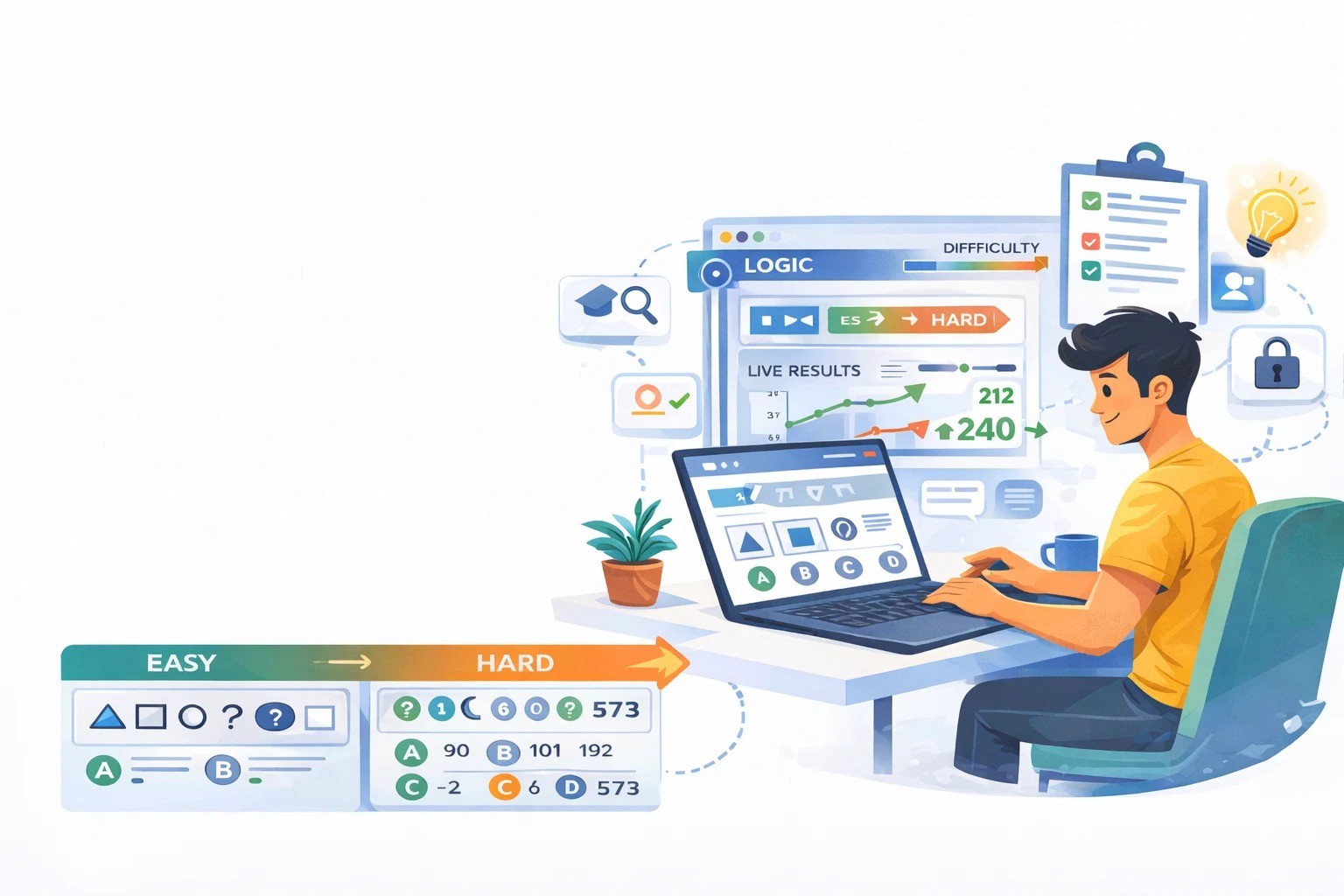
Fresher hiring has changed significantly in recent years, especially with the rise of adaptive online assessments. These tests are increasingly used by Indian IT companies to handle large applicant volumes while evaluating candidates more fairly and accurately.
Unlike traditional fixed-question tests, adaptive tests adjust in real time based on a candidate’s responses. This shift is changing how freshers are screened—and how they should prepare.
What Are Adaptive Tests?
An adaptive test is a type of online assessment that automatically adjusts its difficulty as you progress. Correct answers lead to tougher questions, while incorrect ones result in questions that are easier or of moderate difficulty.
The goal is not to trick candidates, but to identify their actual skill level efficiently instead of relying on one-size-fits-all question papers.
Why Companies Are Moving to Adaptive Testing

1. Fairer Skill Measurement
In traditional tests, some candidates benefit simply because the paper matches what they memorised. Adaptive tests reduce this advantage. Since questions evolve dynamically, scores reflect depth of understanding, not familiarity with a fixed pattern.
2. Better Differentiation at Scale
In pool campus and off-campus drives, thousands of freshers take the same test. Adaptive testing helps companies distinguish:
average performers
strong logical thinkers
high-potential candidates
even when scores look similar in fixed tests.
How Adaptive Tests Reduce Guesswork
In fixed online tests, guessing a few answers correctly can inflate scores. In adaptive tests, random guessing is quickly exposed. A guessed correct answer is followed by a tougher question, which usually reveals whether the candidate actually understands the topic.
This makes adaptive tests more resistant to shortcuts and surface-level preparation.
Focus Shifts from Speed to Thinking
Adaptive assessments care less about how many questions you attempt and more about how you handle increasing difficulty. Rushing through questions without understanding often leads to rapid difficulty spikes and score drops.
Candidates who:
read carefully
think step by step
stay calm under pressure
tend to perform better—even if they attempt fewer questions.
Why Adaptive Tests Matter for Freshers

From a hiring perspective, adaptive tests help answer an important question early:
“Can this fresher handle unfamiliar problems?”
That ability is critical in IT roles where tools, technologies, and requirements keep changing. Adaptive testing gives recruiters an early signal of trainability and problem-solving ability.
What This Means for Fresher Preparation
Adaptive tests reward:
strong fundamentals
logical reasoning
conceptual clarity
They punish:
rote memorisation
pattern-based guessing
speed without accuracy
Freshers who practise understanding concepts deeply—rather than solving repetitive mock papers—are better prepared for adaptive assessments.
The Reality Check
Adaptive tests are not more difficult, but they are strict about understanding concepts properly.
They don’t expect perfection, but they do expect honest thinking.
Final Takeaway
Adaptive tests are changing fresher hiring by shifting focus from how much you remember to how well you think. For freshers, this is a positive change—because genuine understanding now matters more than shortcuts.
If you prepare with clarity, logic, and patience, adaptive tests work in your favour.